
Search
Remove Ads
Advertisement
Search Results

Definition
Diego de Almagro
Diego de Almagro (c. 1475-1538) was a Spanish conquistador who was second-in-command to Francisco Pizarro (c. 1478-1541) during his expedition that attacked the Inca civilization from 1531. Almagro then led his own expedition...
Definition
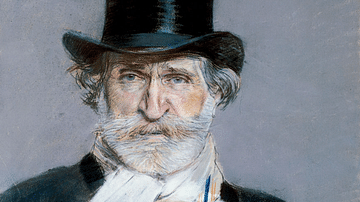
Giuseppe Verdi
Giuseppe Verdi (1813-1901) was an Italian composer best known for operas such as Rigoletto, La traviata, and Aida. Verdi is noted for his powerful scores and strong characters where anti-heroes lead the dramatic action through...

Definition
War of the Fourth Coalition
The War of the Fourth Coalition (October 1806 to June 1807) was a major conflict during the Napoleonic Wars (1803-1815). The Fourth Coalition consisted of Russia, Prussia, Saxony, Sweden, and the United Kingdom, against...

Definition
Peter the Great
Peter I of Russia (Peter the Great) was the Tsar of Russia from 1682-1721 and Emperor of Russia from 1721-1725. During his long reign, Peter had absolute power and brought real change to Russia, including building its first navy...

Definition
Red Cloud
Red Cloud (Makhpiya-luta, l. 1822-1909) was an Oglala Lakota Sioux chief, statesman, and military strategist who became the only Native American leader of the Plains Indians to win a war against the United States. Red Cloud's War (1866-1868...

Definition
Beer Hall Putsch
The Beer Hall Putsch or Munich Putsch was a failed attempt by the German National Socialist (Nazi) Party to seize power, first of the Bavarian and then the German federal government on 8-9 November 1923. The coup, led by Adolf...
Definition
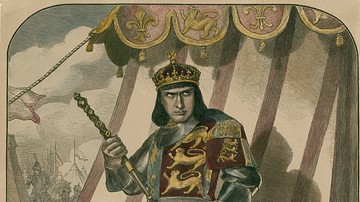
The Tragedy of Richard III - Shakespeare's First Great Villain
The Tragedy of Richard III, often referred to as simply Richard III, is a history play by William Shakespeare (1564-1616), probably written around 1592-94. It is the fourth and final installment...

Definition
Jupiter
Among the many gods of the Romans, Jupiter, the son of Saturn, was the supreme god, associated with thunder, lightning, and storms. The first citizens of what would become Rome believed they were watched over by the spirits of their...

Definition
Heraclius
Heraclius (Herakleios) was emperor of the Byzantine Empire from 610 to 641 CE. He crushed the Persian empire and returned the looted True Cross to Jerusalem, but the second half of his reign was beset by intrigues and ecclesiastical...

Definition
Pythagoras
Pythagoras (l.c. 571 to c. 497 BCE) was a Greek philosopher whose teachings emphasized the immortality and transmigration of the soul (reincarnation), virtuous, humane behavior toward all living things, and the concept of "number"...
