
Search
Remove Ads
Advertisement
Search Results

Article
Martin Luther's 95 Theses
Martin Luther's 95 Theses of 31 October 1517, although they have since come to represent the beginning of the Protestant Reformation, were not written to challenge the authority of the Roman Catholic Church but were simply...

Article
Zengids & the Crusaders: Race for Egypt (1163-1169 CE)
In the aftermath of the failure of the Second Crusade (1147-1149 CE), which only managed to bring Damascus under Nur ad-Din's (sometimes also given as Nur al-Din, l. 1118-1174 CE) dominion, Egypt...

Article
Hymn to Nisaba - A Praise Song for the Sumerian Goddess of Writing
The Hymn to Nisaba (circa 3rd millennium BCE) is a poem praising Nisaba, the Sumerian goddess of writing and accounts who also served as scribe of the gods. The poem is officially dedicated...

Article
Byzantine Icons
Icons, that is images of holy persons, were an important part of the Byzantine Christian Church from the 3rd century CE onwards. Venerated in churches, public places, and private homes, they were often believed to have protective...

Article
Luther's Speech at the Diet of Worms
Martin Luther's speech at the Diet of Worms (also known as the Here I Stand Speech) is considered one of the greatest pieces of oratory in world history. It was given in response to the council's questions on whether...

Article
Argula von Grumbach's To the University of Ingolstadt
To the University of Ingolstadt (1523) is an open letter by the German reformer Argula von Grumbach (l. 1490 to c. 1564) protesting the dismissal, arrest, and imprisonment of the young scholar Arsacius...
Image
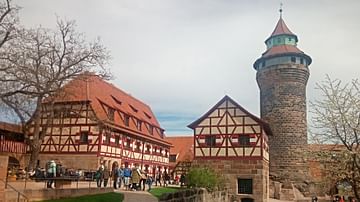
Nuremberg Castle
The Imperial Castle is Nuremberg's landmark, a symbol for the power and importance of the Holy Roman Empire. Nuremberg (Nürnberg), first documented as a royal estate in 1050, was an important base for the domestic power politics...

Image
Map of the Early Christian Pilgrimage (4th-5th Century)
The rise of Christian pilgrimage begins after the conversion of Emperor Constantine (reign 306–337 CE) and the legalization of Christianity in the Edict of Milan (313 CE). The word pilgrim comes...

Definition
Mesopotamian Religion - Daily Life as a Form of Worship
Mesopotamian religion was central to the people's lives. Humans were created as co-laborers with their gods to hold off the forces of chaos and to keep the world running smoothly. As in ancient Egypt...

Definition
The Vedas
The Vedas are the religious texts which inform the religion of Hinduism (also known as Sanatan Dharma meaning “Eternal Order” or “Eternal Path”). The term veda means “knowledge” in that they are thought to contain the fundamental knowledge...
