
Search
Did you mean: Greek Fire?
Remove Ads
Advertisement
Search Results
Image
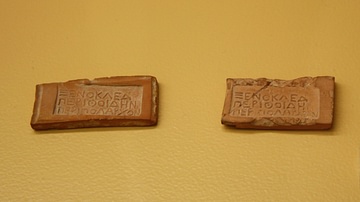
Greek Clay Passport Tokens
Clay tokens probably used as passports by travellers or messengers reporting between military headquarters. Belonging to Xenokles, a border commander, 4th century BCE. (Agora Museum, Athens)
Image
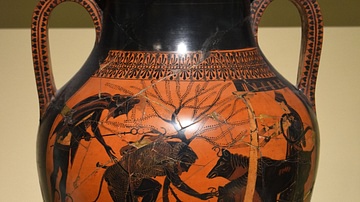
Black Figured Greek Amphora
This black figured amphora was made by the Andokides Painter of Attica, and it dates from c. 530 BCE. It is made of clay and special glaze. (Pushkin Museum, Moscow)
Image
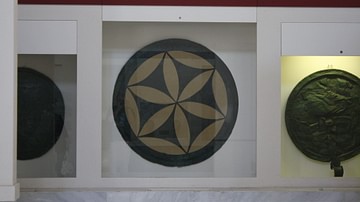
Greek Bronze Shield
Bronze shield from Olympia, 6th century BCE.
Olympia Archaeological Museum.

Image
Greek Foot Race
Attic black-figure column crater depicting a foot race (510-500 BCE). Olympia Archaeological Museum.
Image
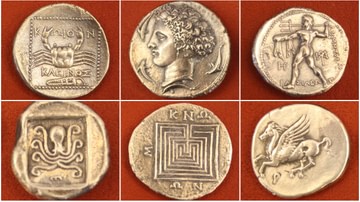
Greek Coins
Top row (L to R): Cos (300-190 BCE) Silver tetradrachm, crab. Syracuse (c. 400 BCE) - Silver decadrachm, head of Arethousa with dolphins. Macedon (306-283 BCE) - Silver tetradrachm, Poseidon with trident. Bottom row (L to...
Image
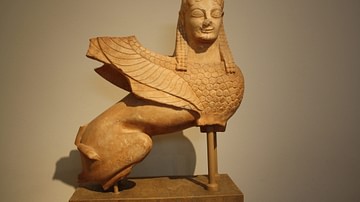
Greek Funerary Sphinx
A sphinx in pentelic marble, from a funerary stele, c. 570 BCE.
National Archaeological Museum, Athens.
Definition
Roman Religion
In many societies, ancient and modern, religion has performed a major role in their development, and the Roman Empire was no different. From the beginning Roman religion was polytheistic. From an initial array of gods and spirits...

Image
Map of the Greek City-states c. 500 BCE
This map illustrates the city-states of Classical Greece around 500 BCE, highlighting the rise of the polis system and the growing reach of Hellenic influence along the Mediterranean and Black Sea coasts. The...

Image
Celtic Coin from Thrace Copying Greek Inscription
Early Iron Age Celtic people copied Greek coins, often faithfully reproducing their designs and inscriptions. This suggests that Thracian die-engravers were illiterate, as legible Greek letters were...

Image
Greek Peplos Dress
A Roman period statue of possibly Kore-Persephone, the daughter of Demeter. The head in fact is restored after a head of Apollo. She is sculpted in the style of 5th century BCE Greek statues and is wearing a peplum, a common...
