
Search
Did you mean: Greek Fire?
Remove Ads
Advertisement
Search Results
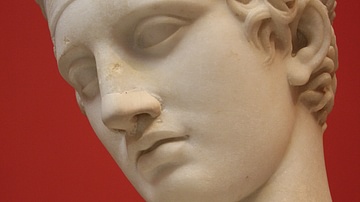
Image
Greek Athlete
A Greek athlete wearing the ribbon of victory (diadoumenos). 1st century BCE copy of a 5th century BCE original by Polykleitos, Delos. (National Archaeological Museum, Athens)

Image
Greek Himation Robe
A Greek youth named Kleonikos wearing a himation robe. From the Gymnasium at Eretrea, Euboea, 1st century BCE. (National Archaeological Museum, Athens)
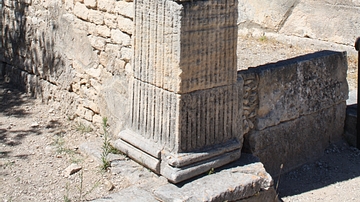
Image
Square Column, Greek-Style House, Glanum
An unuusual square column from the peristyle of a Greek-style house at Glanum, southern France. 2nd-1st century BCE.

Image
Greek Articulated Doll
An articulated terracotta doll and figure representing a baker from a child's tomb at Greek Empuries (Emporiae), Spain. 5th-4th century BCE. (Archaeological Museum, Empuries)

Image
Greek Ship's Anchor
A stone anchor from a Greek sailing vessel, Piraeus. (Archaeological Museum, Piraeus)

Image
Greek Bronze Ballot Disks
Bronze ballot disks used in Greek courts to vote guilty (a hole in the centre) or innocent (a solid centre). c. 300 BCE. (Agora Museum, Athens)
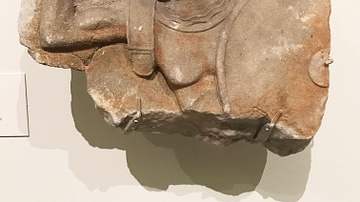
Image
Relief of a Greek Warrior
This relief of a Greek warrior dates from 600-50 BCE. It is made from marble. (Iris & B. Gerald Cantor Center for Visual Arts at Stanford University, Stanford, California)

Image
Head of a Greek Youth
This is the head of a statue of a Greek youth or Kouros. The rest of the body is in the Samos Museum; the whole statue would measure about 3.2 meters in height. His hair is plaited and falls behind the head, down to the neck...

Image
Greek Slave Handcuffs
Bronze slave handcuffs from the Greek colony of Heraclea in southern Italy. 4th-2nd century BCE. (Archaeological Museum, Policoro, Italy)
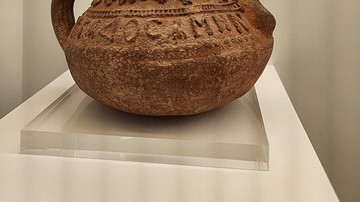
Image
Oil Lamp with Running Animals & Greek Inscription
From a workshop in Upper Egypt.
The Greek inscription says "The Holy and Consubstantial Trinity Amen."
4th-5th century CE. Made from clay. (Hellenic Museum, Melbourne, Victoria).
