
Search
Did you mean: Greek Fire?
Remove Ads
Advertisement
Search Results
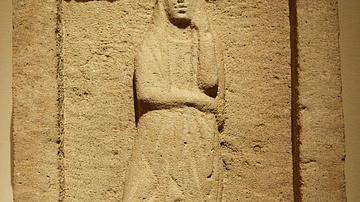
Image
Gravestone of Greek Woman from Black Sea
Limestone grave-stela of a Greek woman from the Black Sea. Cape Tuzla (Taman, Russia), c. 100 BCE-100 CE. (Pushkin Museum, Moscow)

Image
Greek Chariot Racers
Greek chariot racers from the base of a funerary kouros, later included in the Themistokleian Wall of Athens. 510-500 BCE. (National Archaeological Museum, Athens)

Image
Greek Harbour of Phalasarna, Crete
View of the harbour of the Greek city of Phalaserna on the island of Crete. The harbour was constructed around 335 BCE and was protected on all sides by defending walls and towers.

Image
Greek Wrestlers
A relief from a funerary kouros base depicting two Greek wrestlers, one of the sports at such events as the Olympic Games at Olympia. c. 510 BCE. (National Archaeological Museum, Athens)

Image
Greek Himation Robe
A Greek youth named Kleonikos wearing a himation robe. From the Gymnasium at Eretrea, Euboea, 1st century BCE. (National Archaeological Museum, Athens)
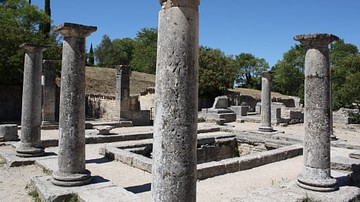
Image
Greek-Style House, Glanum
The peristyle of a Greek-style house at Glanum, southern France. 2nd-1st century BCE.
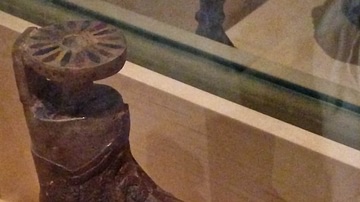
Image
Ancient Greek Sandal
Similar to the ancient Egyptians, the ancient Greeks favoured sandals. However, rather than using vegetable fibre, the Greek preferred leather with cork or leather soles. Varying footwear styles reflected the differences of...
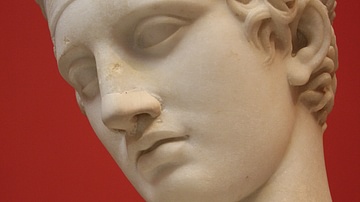
Image
Greek Athlete
A Greek athlete wearing the ribbon of victory (diadoumenos). 1st century BCE copy of a 5th century BCE original by Polykleitos, Delos. (National Archaeological Museum, Athens)
Image
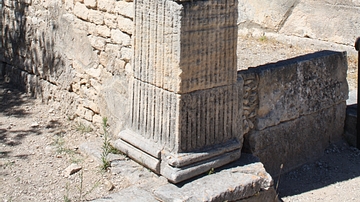
Square Column, Greek-Style House, Glanum
An unuusual square column from the peristyle of a Greek-style house at Glanum, southern France. 2nd-1st century BCE.

Definition
Apollo
Apollo was a Greek god associated with the bow, music, and divination. The epitome of youth and beauty, source of life and healing, patron of the arts, and as bright and powerful as the sun itself, Apollo was perhaps the most loved of...
