
Search
Did you mean: Noah?
Remove Ads
Advertisement
Search Results

Definition
Sarpedon
Sarpedon is a figure from ancient Greek mythology, a Lycian prince who was one of the principal heroes during the Trojan War and fought on the side of Troy. According to Homer's Iliad, he was the son of Zeus by Laodameia and the cousin of...

Definition
Cyclops (Play)
The satyr-play The Cyclops was written by Euripides, one of the great Greek tragedians, in 412 or 408 BCE. Like many of his fellow tragedians, Euripides centers his play on a well-known story from Greek mythology. The Cyclops is based on...

Definition
Arretium
Arretium (modern Arezzo) was an important Etruscan town located in the extreme north-east of Etruria in central Italy. Flourishing as a trade and manufacturing centre, Arretium managed to overcome its rivalry with Rome and continue as a prosperous...

Definition
As You Like It - Learning to Love in Shakespeare's Forest of Arden
As You Like It is a pastoral comedy by William Shakespeare (1564-1616), written in 1599 and likely first performed that same year. Indeed, it is thought to be the inaugural show performed by Shakespeare's acting company, the Lord Chamberlain's...
Definition
Cilicia Campestris
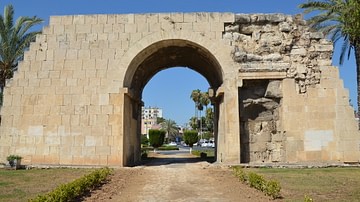
Cilicia Campestris was one of the six districts of the Roman province of Cilicia organized by Pompey the Great (l. c. 106-48 BCE) in 64 BCE. The name translates roughly into “Cilicia of the Plains” and corresponds to the earlier name for...

Definition
Glanum
Glanum, located near St-Rémy-de-Provence in southern France, was a Greek and then Roman town which prospered due to its location on trading routes between Italy and the Rhodanus (Rhone River). The town benefitted from a large building project...

Definition
Claude Brousson
Claude Brousson (l. 1647-1698) was a prolific writer and famous preacher after the revocation of the Edict of Nantes in 1685 when Protestantism was outlawed in France. He self-exiled to Lausanne and Holland and returned to France to preach...
Image
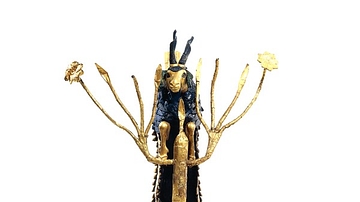
Ram in a Thicket
From Ur, southern Iraq, about 2600-2400 BC This is one of an almost identical pair discovered by Leonard Woolley in the 'Great Death Pit', one of the graves in the Royal Cemetery at Ur. The other is now in the University of Pennsylvania...
Image
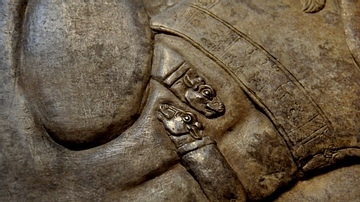
Assyrian Armlet
A close-up view of the right arm of a human-headed and winged protective spirit, Apkallu (or Sage). There is an armlet which embraces the right biceps muscle. The armlet's ends are sheep-headed. Note the decorations on the lower end of the...

Article
Inventions & Innovations of Ancient Persia
Ancient Persian culture contributed many of the aspects of the modern world which people take for granted as having always existed. The designation “Persia” comes from the Greeks – primarily from the historian Herodotus – but the people of...
