
Search
Did you mean: Franks?
Remove Ads
Advertisement

 This answer was generated by
 Search Results

Article
France’s 1905 Law of Separation of Church and State
The 1905 Law of Separation of Church and State was enacted as the climax of decades of conflict between monarchists and anticlerical Republicans who viewed Christianity as a permanent obstacle to the...

Collection
France v England: The 100 Years' War
There was a bitter rivalry between France and England throughout the 14th and 15th century CE and their frequent battles in this period are now known to history as the Hundred Years' War (1337-1453 CE). In this...

Definition
Louis XIV of France - The Sun King
Louis XIV (1638-1715) reigned as King of France from 1643 to 1715. Known as Le Roi Soleil ('the Sun King'), he fervently believed in the concept of the 'divine right' of kings and is remembered for ruling as an absolute...

Definition
Isabella of France
Isabella of France (c. 1292-1358) was the queen consort of Edward II of England (r. 1307-1327). After heading a coup to overthrow her husband, she ruled as regent for their young son, Edward III of England (r. 1327-1377) until...

Definition
Louis XVI of France
Louis XVI (l. 1754-1793) was the last king of France (r. 1774-1792) before the monarchy was abolished during the French Revolution (1789-99). An indecisive king, his attempts to navigate France through the crises of the 1780s...
Definition
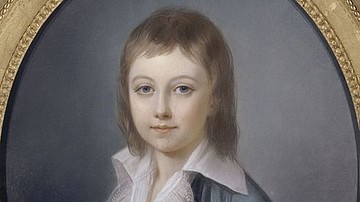
Louis XVII of France
Louis XVII of France was the regnal name of Louis-Charles de France (l. 1785-1795), the younger son of King Louis XVI of France (r. 1774-1792) and Queen Marie Antoinette (l. 1755-1793). Although Louis-Charles never actually...

Image
France, c. 1420 CE
Map of France during the Hundred Years' War (1337-1453 CE), around the time of the Treaty of Troyes (1420 CE).
Image
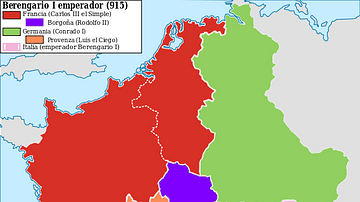
France During the Reign of Charles the Simple
A map indicating in red the territory controlled by Charles the Simple, aka Charles III of West Francia (r. 893-923 CE)

Definition
Charles VI of France - The Mad King
Charles VI (lived 1368-1422) reigned as King of France from 1380 to 1422, during an important phase of the Hundred Years' War (1337-1453) against England. Known as the 'Mad King' due to his frequent bouts with psychosis...

Definition
Marie de France
Marie de France (wrote c. 1160-1215 CE) was a multilingual poet and translator, the first female poet of France, and a highly influential literary voice of 12th-century CE Europe. She is credited with establishing the literary...
