
Search
Remove Ads
Advertisement
Search Results

Definition
Fire Temple
Fire Temples are places of worship in the Zoroastrian religion. They were known as ataskada (“house of fire”) by the Persians but are best known today by their Greek name pyratheia (fire temple). They are thought to have originated...

Definition
Jan Hus
Jan Hus (also John Huss, l. c. 1369-1415) was a Czech philosopher, priest, and theologian who, inspired by the work of John Wycliffe (l. 1330-1384) challenged the policies and practices of the medieval Church and so launched the Bohemian...

Definition
Pharisees
The Pharisees were a Jewish sect that emerged c. 150 BCE and promoted the idea of priestly purity for all Jews, belief in providence or fate, and the concept of the resurrection of the dead, and taught that besides the commandments...

Definition
Plains Indians
The Plains Indians (also known as Native Americans of the Plains and Prairie, Indigenous Peoples of the Great Plains) are the original inhabitants of the western plains of North America, now part of the United States and Canada...

Definition
Ashurbanipal
Ashurbanipal (r. 668-627 BCE, also known as Assurbanipal) was the last of the great kings of Assyria. His name means "the god Ashur is creator of an heir" and he was the son of King Esarhaddon of the Neo-Assyrian Empire. In the Hebrew...

Article
The Five Gifts of Hathor: Gratitude in Ancient Egypt
The central cultural value of ancient Egypt was ma'at – harmony and balance – which maintained the order of the universe and the lives of the people. Keeping balance in one's life encouraged the same...

Article
The Temple of Hatshepsut
Among the duties of any Egyptian monarch was the construction of monumental building projects to honor the gods and preserve the memory of their reigns for eternity. These building projects were not just some grandiose...
Article
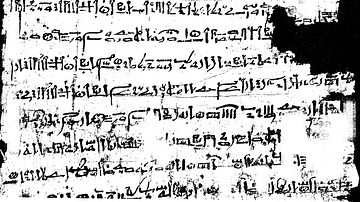
The Report of Wenamun & the Perils of Living in the Past
The Report of Wenamun (also known as The Tale of Wenamun or The Report of Wenamon) is an Egyptian literary work dated to c. 1090-1075 BCE toward the end of the New Kingdom (c.1570 - c. 1069 BCE...
Article
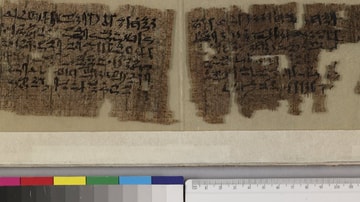
The Tale of Sinuhe
The Middle Kingdom of ancient Egypt (2000 BCE – 1700 BCE) saw the start of more formal writing which included religious scripts, administrative notes, and more in-depth fictional writing. One of the most iconic pieces of writing...

Definition
Eridu Genesis - The Oldest Mesopotamian Text on the Great Flood
The Eridu Genesis (also known as the Sumerian Flood Story, The Flood Story, Sumerian creation myth, Sumerian deluge myth) is the oldest Mesopotamian text relating the tale of the Great Flood...
