
Search
Remove Ads
Advertisement
Search Results

Article
Ghosts in the Middle Ages
The medieval Church informed the people's religious imagination during the Middle Ages (c. 476-1500) and the world was therefore interpreted - even by heterodox Christians - through the Church's lens. Ghosts – referred...

Article
Zwingli's On Rejecting Lent and Protecting Christian Liberty
Although Huldrych Zwingli (l. 1483-1531) began his Reformation efforts in Zürich in 1519, his first break with the Church came in 1522 when he defended a group of citizens who had broken the...

Article
Mummification in Ancient Egypt
The practice of mummifying the dead began in ancient Egypt c. 3500 BCE. The English word mummy comes from the Latin mumia which is derived from the Persian mum meaning 'wax' and refers to an embalmed corpse which was...

Article
Ships of the Gods of Ancient Egypt
The Nile River was the source of life for the ancient Egyptians and so figured prominently in their religious beliefs. At night, the Milky Way was considered a heavenly Nile, associated with Hathor, and provider...

Article
Ethnicity & Identity Within the Four-Room House
The process of determining ethnicity is a problematic venture, even more so when interpreted through the archaeological record. Despite this issue, evidence, such as the four-room house, has been preserved...

Definition
Indus Valley Civilization
The Indus Valley Civilization was a cultural and political entity which flourished in the northern region of the Indian subcontinent between c. 7000 - c. 600 BCE. Its modern name derives from its location in the valley...

Definition
Giza
Giza is a plateau southwest of modern Cairo which served as the necropolis for the royalty of the Old Kingdom of Egypt. Most famous for the pyramids of Khufu (completed c. 2560 BCE) Khafre (c. 2530 BCE) and Menkaure (c. 2510 BCE) and the...

Definition
Amenhotep III
Amenhotep III (c. 1386-1353 BCE) was the ninth king of the 18th Dynasty of Egypt. He is also known as Nebma'atre, Amenophis III, Amunhotep II, and Amana-Hatpa, all of which relate to the concept of the god Amun being satisfied or...
Article
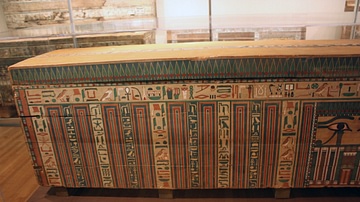
The Coffin Texts
The Coffin Texts (c. 2134-2040 BCE) are 1,185 spells, incantations, and other forms of religious writing inscribed on coffins to help the deceased navigate the afterlife. They include the text known as the Book of Two Ways which...
Article
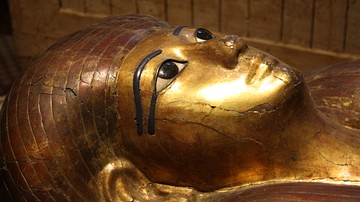
Herodotus on Burial in Egypt
Herodotus' section of his Histories on burial in ancient Egypt (Book II.85-90) is an accurate description of Egyptian mummification, but he purposefully omits the spiritual significance of embalming in keeping with his...
