
Search
Remove Ads
Advertisement
Search Results

Definition
Julius Caesar
Gaius Julius Caesar was born 12 July 100 BCE (though some cite 102 as his birth year). His father, also Gaius Julius Caesar, was a Praetor who governed the province of Asia and his mother, Aurelia Cotta, was of noble birth. Both...

Definition
Script - The Written Record of Humanity
Script is the written expression of a language. Cuneiform, the first script, was invented in Sumer, Mesopotamia, circa 3600/3500 BCE; hieroglyphics sometime prior to the Early Dynastic Period in Egypt (circa...

Definition
Kadesh
Kadesh was a city in the region of Syria and an important center of trade in the ancient world. It is probably best known as the site of the famous battle between Pharaoh Ramesses II (The Great, 1279-1213 BCE) of Egypt and King Muwatalli...

Definition
Old Kingdom of Egypt - The Age of the Pyramids
The Old Kingdom of Egypt (circa 2613-2181 BCE) is also known as the "Age of the Pyramids" or "Age of the Pyramid Builders" as it includes the great 4th Dynasty when King Sneferu perfected the art of pyramid...

Definition
Burial
Burial of the dead is the act of placing the corpse of a deceased person in a tomb constructed for that purpose or in a grave dug into the earth. Archaeological excavations have revealed Neanderthal graves dating back 130,000 years, marking...

Definition
Great Pyramid of Giza
The Great Pyramid of Giza is a defining symbol of Egypt and the last of the ancient Seven Wonders of the World. It is located on the Giza plateau near the modern city of Cairo and was built over a twenty-year period during...

Article
Shabti Dolls: The Workforce in the Afterlife
The Egyptians believed the afterlife was a mirror-image of life on earth. When a person died their individual journey did not end but was merely translated from the earthly plane to the eternal. The soul...
Article
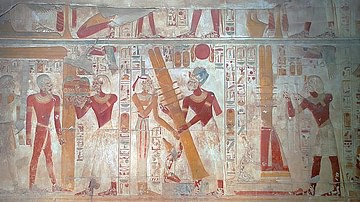
The Forty-Two Judges
The Forty-Two Judges were divine entities associated with the afterlife in ancient Egypt and, specifically, the judgment of the soul in the Hall of Truth. The soul would recite the Negative Confession in their presence as...
Article
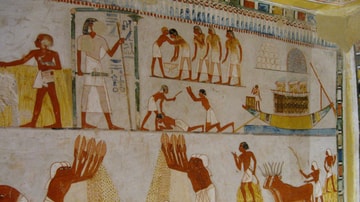
Jobs in Ancient Egypt
In ancient Egypt, the people sustained the government and the government reciprocated. Egypt had no cash economy until the coming of the Persians in 525 BCE. The people worked the land, the government collected the bounty...

Article
Beer in Ancient Egypt
Considering the value the ancient Egyptians placed on enjoying life, it is no surprise that they are known as the first civilization to perfect the art of brewing beer. The Egyptians were so well known as brewers, in fact...
