
Search
Remove Ads
Advertisement
Search Results

Definition
Ashurbanipal
Ashurbanipal (r. 668-627 BCE, also known as Assurbanipal) was the last of the great kings of Assyria. His name means "the god Ashur is creator of an heir" and he was the son of King Esarhaddon of the Neo-Assyrian Empire. In the Hebrew...

Article
The Temple of Hatshepsut
Among the duties of any Egyptian monarch was the construction of monumental building projects to honor the gods and preserve the memory of their reigns for eternity. These building projects were not just some grandiose...

Article
Conflict Between the Temple and the Crown in Ancient Egypt
The gods of ancient Egypt were worshipped as the creators and sustainers of all life. People acknowledged their supremacy and intimacy daily through rituals, amulets, and their labor for the king...
Article
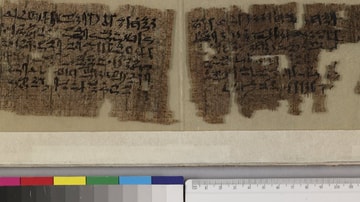
The Tale of Sinuhe
The Middle Kingdom of ancient Egypt (2000 BCE – 1700 BCE) saw the start of more formal writing which included religious scripts, administrative notes, and more in-depth fictional writing. One of the most iconic pieces of writing...

Definition
Hipparchus of Nicea - Greatest Astronomer of His Time
Hipparchus of Nicea (l. c. 190 - c. 120 BCE) was a Greek astronomer, geographer, and mathematician regarded as the greatest astronomer of antiquity and one of the greatest of all time. He is best known...

Definition
Pi-Ramesses
Pi-Ramesses (also known as Per-Ramesses, Piramese, Pr-Rameses, Pir-Ramaseu) was the city built as the new capital in the Delta region of ancient Egypt by Ramesses II (known as The Great, 1279-1213 BCE). It was located at the site...

Definition
Mahmud II - Reformist Sultan of the Ottoman Empire
Mahmud II was one of the most influential sultans of the Ottoman Empire. As a radical reformer, he strove to implement military and governmental reforms to prevent the empire from collapsing. His removal...

Definition
Ptolemy I
Ptolemy I Soter (366-282 BCE) was one of the successor kings to the empire of Alexander the Great. He served not only as king of Egypt but also the founder of the Ptolemaic Dynasty, a dynasty which included the infamous Cleopatra VII...

Definition
Civilization - From Nomadic Life to the Farm and City
Civilization (from the Latin civis=citizen and civitas=city) is a term applied to any society which has developed a writing system, government, production of surplus food, division of labor, and urbanization...

Definition
Near East - A Modern Term for an Ancient Land
The 'Near East' is a modern-age term for the region formerly known as the 'Middle East,' comprising Armenia, Cyprus, Egypt, Iraq, Iran, Israel, Jordan, Lebanon, Palestine, Syria, and part of Turkey, corresponding...
