
Search
Remove Ads
Advertisement
Search Results
Definition
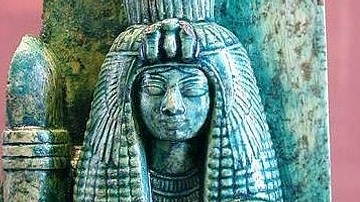
Tiye
Tiye (also known as Tiy, 1398-1338 BCE) was a queen of Egypt of the 18th dynasty, wife of the pharaoh Amenhotep III, mother of Akhenaten, and grandmother of both Tutankhamun and Ankhsenamun. She exerted an enormous influence at the courts...

Definition
Palestine - The Ancient Land of Canaan
In the ancient world, Palestine was part of the region known as Canaan, where the Kingdoms of Israel and Judah were located. The term "Philistia" (from which "Palestine" comes) initially referred to an area of...

Definition
Ptolemy II Philadelphus
Ptolemy II Philadelphus ("The Sibling Loving", r. 282-246 BCE) was the second ruler of the Ptolemaic Dynasty. He consolidated the kingdom conquered by his father Ptolemy I and presided over its golden age. Ptolemy II invested...

Quiz
Egyptian Pyramids, Hieroglyphics, & Art
Egyptian Pyramids, The Sphinx, Egyptian Art, Egyptian Symbols, Egyptian Architecture, Egyptian Hieroglyphics, The Rosetta Stone

Lesson Pack
Religion in Ancient Egypt
We have prepared three lesson plans including classroom activities, assignments, homework, and keys as well as: - Multiple choice quiz questions in an excel format. - Glossary of keywords and concepts in an excel format...
Article
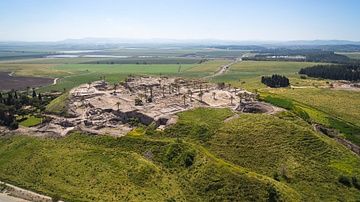
Thutmose III at The Battle of Megiddo
The ancient site of Megiddo was the scene of a number of battles in antiquity and is best known as the source of the word armageddon, the Greek rendering of the Hebrew Har-Megiddo ('Mount of Megiddo') from the...

Article
Thutmose III's Battle of Megiddo Inscription
The Battle of Megiddo (c. 1457 BCE) is one of the most famous military engagements in history in which Thutmose III (1458-1425 BCE) of Egypt defeated the coalition of subject regions led in rebellion by...

Article
Games, Sports & Recreation in Ancient Egypt
Although the ancient Egyptians are often depicted as death-obsessed and dour, they actually had a great appreciation for life and their culture reflected their belief in existence as an eternal journey imbued...
Article
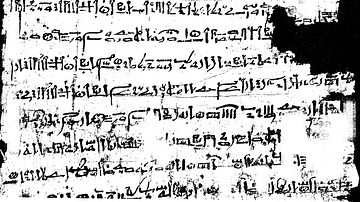
The Report of Wenamun & the Perils of Living in the Past
The Report of Wenamun (also known as The Tale of Wenamun or The Report of Wenamon) is an Egyptian literary work dated to c. 1090-1075 BCE toward the end of the New Kingdom (c.1570 - c. 1069 BCE...

Video
Shabti Dolls of Ancient Egypt - Helpers in the Afterlife
Shabti dolls from Ancient Egypt were funerary figures that accompanied the deceased into the afterlife and were basically your personal helper in the afterlife. A shabti formula (which was a spell...
