
Search
Remove Ads
Advertisement
Search Results

Definition
Ramesses II
Ramesses II (r. 1279-1213 BCE, alternative spellings: Ramses, Rameses) was known to the Egyptians as Userma'atre'setepenre, which means 'Keeper of Harmony and Balance, Strong in Right, Elect of Ra'. He is also known also as Ozymandias...

Definition
Indus Valley Civilization
The Indus Valley Civilization was a cultural and political entity which flourished in the northern region of the Indian subcontinent between c. 7000 - c. 600 BCE. Its modern name derives from its location in the valley...

Definition
Ptolemaic Army
The army of Ptolemaic Egypt was a well-organized fighting force trained in Hellenistic warfare. The Ptolemaic dynasty used their considerable wealth to maintain a large standing army of professional soldiers. Some troops were paid...
Definition
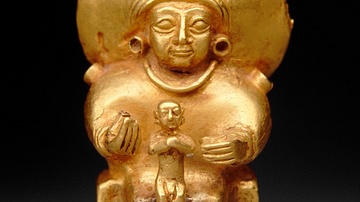
Sauska - The Hurrian's Radiant Goddess of Fertility and War
Sauska (also known as Shaushka, Sausga, and Anzili) was the Hurrian-Hittite goddess of fertility, war, and healing. She was worshipped throughout the region known as Hanigalbat (present day Iraq...

Definition
Ancient Jordan
Jordan is a country in the Near East bordered by Israel, Syria, Iraq, and Saudi Arabia. The country's name comes from the Arabic Al Urdun, referencing a fortified site but also meaning "prominence", though various sources also...

Definition
Greek Philosophy
Ancient Greek philosophy is a system of thought, first developed in the 6th century BCE, which was informed by a focus on the First Cause of observable phenomena. Prior to the development of this system by Thales of Miletus (l...

Definition
Mitanni
The Kingdom of Mitanni, known to the people of the land, and the Assyrians, as Hanigalbat and to the Egyptians as Naharin and Metani, once stretched from present-day northern Iraq, down through Syria and into Turkey and was among the...

Article
Unam Sanctam: Spiritual Authority & the Medieval Church
The Unam Sanctam (1302) was a papal bull issued by Pope Boniface VIII (served 1294-1303) requiring the complete submission of all people, including kings, to the authority and dictates of the pope...

Article
The Army of Alexander the Great
No military commander in history has ever won a battle by himself. To be successful he needs the support of a well-trained army who will follow him regardless of the cost whether it be a stunning victory or hopeless...

Article
Athena Parthenos by Phidias
The magnificent temple on the Acropolis of Athens, known as the Parthenon, was built between 447 and 432 BCE in the Golden Age of Pericles, and it was dedicated to the city's patron deity Athena. The temple was constructed...
