
Search
Remove Ads
Advertisement
Search Results
Image
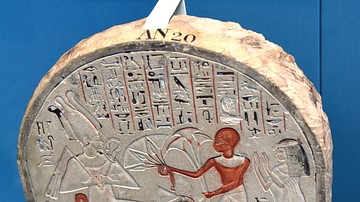
Egyptian Stela of Bakkay
A painted limestone stela where the deceased offers flowers to Osiris. Below, offerings are made to a couple named Huy and Henutnofret by four members of their family. From Egypt. 18th Dynasty, reign of Amenhotep III, circa...

Image
Ancient Egyptian Relief of Working Men
This ancient Egtyptian relief of two men pulling a rope is made from stone and dates from the Intermedite Period or the Early Middle Kingdom (c. 2100-1940 BCE). It originally belonged to a necropolis and was...

Image
Ancient Egyptian Offering Basin
This offering basin made from stone dates from the time that Egypt was a province of the Roman Empire (30 BCE–641 CE). It was carved in the shape of an ankh, which symbolized life. (Musée du Cinquantenaire, Brussels...

Image
Portion of an Ancient Egyptian Stela
This stela is from the tomb of Espotu, a priest of Amun-Re and son of the second prophet of Amun-Re, Ankhefenkhons. In the inscription, he lists the 22 priesthoods he held, detailing his received a salary for each...

Image
Egyptian Fish Coffin
A wooden coffin shaped in the form of a Nile bolti fish and containing the mummified remains of a fish. Dynasty XXX-XXXI, 4th century BCE. (Egytpian Museum, Turin)

Image
Egyptian Vessel with Galloping Horses
On this ceramic vessel, two piebald horses are depicted; they are galloping and harnessed. An ankh sign's hand grasps a was-scepter. Horses were introduced to Egypt by the Hyksos during the Second Intermediate...
Image
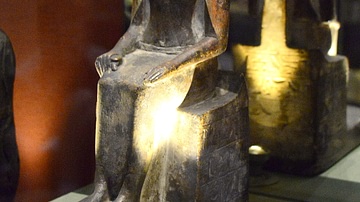
Statue of Egyptian Priest Senemiah
The inscriptions on the sides identify the man as Senemiah, a priest of the Theban moon-god Khons, with the unsual phrase "he whose hands are pure when adorning his god," referring to the daily ritual in which the...

Image
Fractured Femur of an Egyptian Mummy
This right femoral bone shows evidence of malunion and misalignment of a healed fractured. From Abydos, Egypt. Late Period, after 664 BCE. (The British Museum, London)

Image
Egyptian King-list
Monumental lists of past kings expressed the living ruler's legitimacy. Originally, Ramesses II was shown on the far right, honoring previous kings and the god Osiris. The kings were represented by their throne names, written...
Article
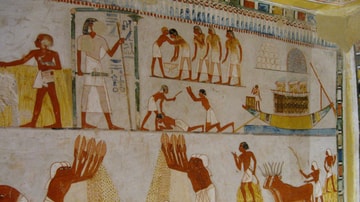
Social Structure in Ancient Egypt
The society of ancient Egypt was strictly divided into a hierarchy with the king at the top and then his vizier, the members of his court, priests and scribes, regional governors (eventually called 'nomarchs'), the...
