
Search
Remove Ads
Advertisement
Search Results
Image
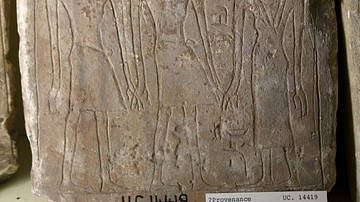
Egyptian Stela of Neferhotep
On this limestone stela, the hieroglyphic inscriptions mention the name of the Overseer of Cattle Neferhotep, son of the Overseer of Cattle Dednub and the chantress Itires. On the lower right border, a standing woman...
Image
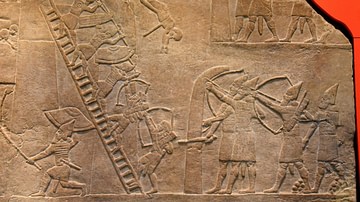
Assyrian Archers Attacking an Egyptian Fortress at Memphis
Detail of a large gypsum wall panel showing the Assyrian army attacking the Egyptian city of Memphis and commemorating the final victory of the Assyrian king Ashurbanipal II over the Egyptian...
Image
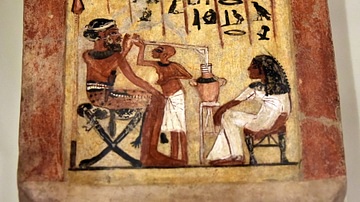
Egyptian Stele of a Syrian Mercenary
A mid 2nd Millennium BCE painted limestone stele showing a Syrian mercenary drinking beer. The mercenary;s name is Terura and his wife's name is Arbura. His facial features and dress clearly identify him as a Syrian...

Image
Egyptian Limestone Fragment with Kheker Frieze
Limestone block carved with a kheker frieze at the upper part, from Kopotos (Qift), Egypt, 1580-1550 BCE. At the lower middle part, we can see the the double plume headdress of the god Min; on its either...

Definition
Karnak
Karnak is the modern-day name for the ancient site of the Temple of Amun at Thebes, Egypt. The Egyptians called the site Nesut-Towi, "Throne of the Two Lands", Ipet-Iset, "The Finest of Seats" as well as Ipt-Swt, "Selected Spot" also...

Image
Ancient Egyptian Offering Basin
This offering basin made from stone dates from the time that Egypt was a province of the Roman Empire (30 BCE–641 CE). It was carved in the shape of an ankh, which symbolized life. (Musée du Cinquantenaire, Brussels...

Image
Portion of an Ancient Egyptian Stela
This stela is from the tomb of Espotu, a priest of Amun-Re and son of the second prophet of Amun-Re, Ankhefenkhons. In the inscription, he lists the 22 priesthoods he held, detailing his received a salary for each...

Image
Egyptian Fish Coffin
A wooden coffin shaped in the form of a Nile bolti fish and containing the mummified remains of a fish. Dynasty XXX-XXXI, 4th century BCE. (Egytpian Museum, Turin)

Image
Egyptian Vessel with Galloping Horses
On this ceramic vessel, two piebald horses are depicted; they are galloping and harnessed. An ankh sign's hand grasps a was-scepter. Horses were introduced to Egypt by the Hyksos during the Second Intermediate...
Image
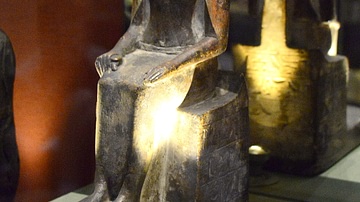
Statue of Egyptian Priest Senemiah
The inscriptions on the sides identify the man as Senemiah, a priest of the Theban moon-god Khons, with the unsual phrase "he whose hands are pure when adorning his god," referring to the daily ritual in which the...
