
Search
Remove Ads
Advertisement
Search Results

Image
Tang Dynasty Glazed Ware
A burial vessel in the form of a flower, Sancal ware, mid-8th century CE, T'ang Dynasty. (Museum of Asian Art, Corfu)

Image
Celadon Fish-Dragon Ewer, Goryeo Dynasty
A celadon fish-dragon ewer. 12th century CE, Goryeo Dynasty, Korea. (National Museum of Korea, Soul, South Korea)

Image
Figure of a Mongol, Yuan Dynasty
A detail of a burnished earthenware figurine of a Mongol. Yuan Dynasty, 14th century CE. H. 11 7/16 in. (29 cm); W. 4 7/16 in. (11.3 cm); D. 3 3/8 in. (8.6 cm). (Metropolitan Museum of Art, New York)

Image
Han Dynasty Sword
A Han dynasty iron sword and scabbard with wood and lacquer decoration, China, 2nd century BCE. (British Museum, London)
Image
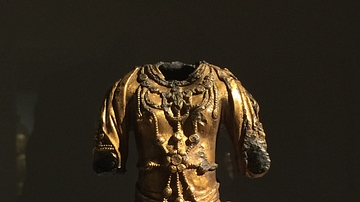
Goryeo Dynasty Bodhisattva
Gilt bronze bodhisattva seated on a lotus leaf. Goryeo Dynasty, 13th century CE. (Musée Guimet, Paris)
Image
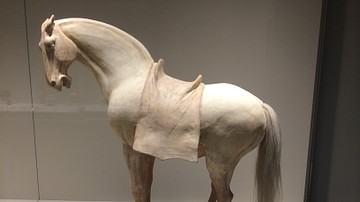
Tang Dynasty Horse
A unglazed ceramic horse from the Tang Dynasty. China, 8th century CE. (St. Louis Art Museum, Missouri)
Image
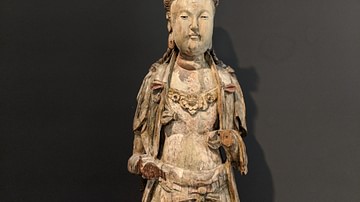
Guanyin, Song Dynasty
Guanyin, the Bodhisattva of Compassion. Song Dynasty (960-1279 CE), China. Wooden, painted and gilded. Exhibited at Museum Rietberg, Zurich, Switzerland.

Image
Bronze Korean Coin, Goryeo Dynasty
A bronze coin of the Korean Goryeo Dynasty, 1097-1105.
The legend reads: Haedong tongbo meaning 'Coin of the Land East of the Sea' (Korea).
The British Musem, London.
Image
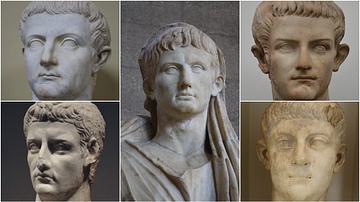
The Julio-Claudian Dynasty
The five Roman emperors of the Julio-Claudian dynasty. These were: - Augustus (r. 27 BCE - 14 CE) - centre photo - Tiberius (r. 14-37 CE) - top left - Caligula (r. 37-41 CE) - top right - Claudius (r. 41-54 CE...

Image
Goryeo Dynasty Bronze Coin
A bronze coin of the Korean Goryeo Dynasty. The legend reads: Tongguk tongbo,
meaning 'Coin of the Eastern Kingdom' (Korea). 1097-1105 CE. (British Musem, London)
