
Search
Remove Ads
Advertisement
Search Results

Image
Goryeo Dynasty Bronze Coin
A bronze coin of the Korean Goryeo Dynasty. The legend reads: Tongguk tongbo,
meaning 'Coin of the Eastern Kingdom' (Korea). 1097-1105 CE. (British Musem, London)
Image
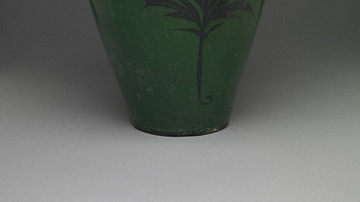
Jurchen Jin Dynasty Vase
A green glazed vase with floral design, Jurchen Jin dynasty, 1115-1234 CE. (British Museum, London)
Image
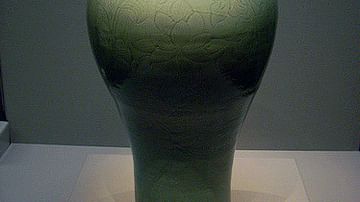
Maebyeong Celadon Vase, Goryeo Dynasty
A maebyeong celadon vase with lotus decoration. 12th century CE, Goryeo Dynasty, Korea. (National Museum of Korea, Seoul, South Korea)
Image
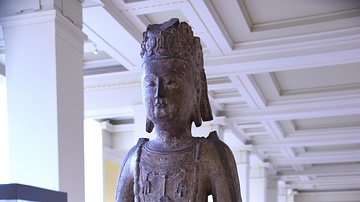
Qi Dynasty Bodhisattva Avalokitesvara
Bodhisattvas are enlighted beings who have chosen to stay in the world to help others achieve Buddhahood. Avalokitesvara is the Bodhisattva of Compassion, known in Chinese as Guanyin. Guanyin is short for Guanshiyin...
Image
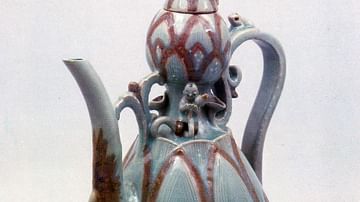
Celadon Ewer, Goryeo Dynasty
A celadon gourd-shaped ewer deocrated with lotus petals. 13th century CE, Goryeo Dynasty, Korea. (Leeum, Samsung Museum of Art, Seoul, South Korea)
Image
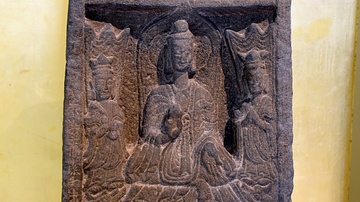
Wei Dynasty Buddhist Stele
This stele is carved with representations of events in the Lotus Sutra, one of the most important texts in early Chinese Buddhism. The Lotus Sutra is reconstructed as a magnificent drama, during which the historical Buddha...
Image
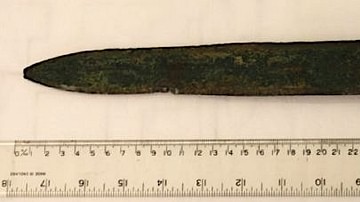
Eastern Zhou Dynasty Sword
A bronze sword from the Eastern Zhou dynasty, China, 5th-3rd century BCE. (British Museum, London)
Image
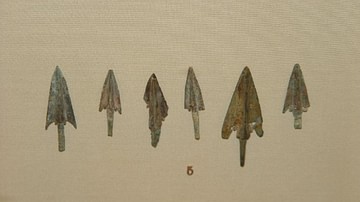
Shang Dynasty Arrowheads
Bronze arrowheads from Shang dynasty China. 1200-1050 BCE. (British Museum, London)
Image
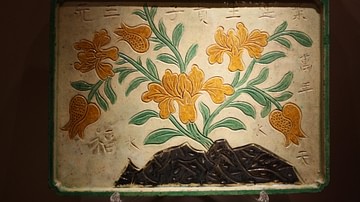
Jin Dynasty Stoneware Tray
A glazed stone tray, 12th century CE, Jin Dynasty. (Museum of Asian Art, Corfu)
Image
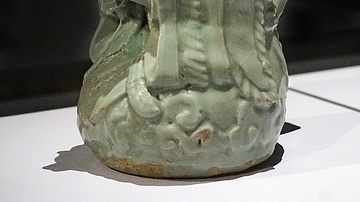
Taoist Figure Celadon Pitcher, Goryeo Dynasty
A celadon pitcher in the form of a Taoist figure. Goryeo Dynasty, 12th century CE, Korea. (National Museum of Korea, Seoul, South Korea)
