
Search
Remove Ads
Advertisement
Search Results
Image
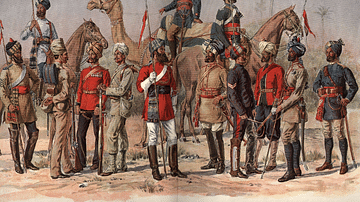
East India Company Madras Army
A 19th-century illustration showing officers and sepoys (Indian recruits) of the East India Company's Madras army.
Image
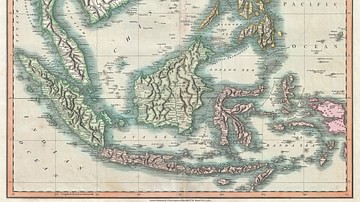
Map of the East Indies and Southeast Asia
An 1801 map of the East Indies and Southeast Asia ( Singapore, Borneo, Sumatra, Java, Philippines).

Image
East Asia in 500 CE
This map shows the territories of all major civilizations in East Asia in the year 500 CE. Italicized texts indicate nomadic bands or tribal societies.

Image
Maji-Maji Rebellion, German East Africa
An early-20th-century painting by Wilhelm Kuhnert depicting German-led African Askari troops at the Battle of Mahenge during the Maji-Maji Rebellion (1905-7) against colonial rule in German East Africa.

Image
East India Company Trooper & Sepoy
An 1839 illustration showing a trooper and sepoy (Indian recruit) of the East India Company army. 27th Regiment of Madras Native Infantry. (British Library, London)

Definition
Estado da India
The Estado da India (1505-1961) was the name the Portuguese gave to that part of their empire which stretched from India to East Asia. However, in its widest sense, the name includes all Portuguese colonies east of the Cape of Good Hope and...

Article
Battle of Fleurus
The Battle of Fleurus (26 June 1794) was the climax of the Flanders Campaign of 1792-95 and was one of the most decisive battles in the War of the First Coalition (1792-1797). A French victory, Fleurus ensured French ascendency for the rest...

Article
Slavery in Plantation Agriculture
The first plantations in the Americas of sugar cane, cocoa, tobacco, and cotton were maintained and harvested by African slaves controlled by European masters. When African slavery was largely abolished in the mid-1800s, the center of plantation...

Image
Map of East Frisia
Map of East Frisia by the Dutch Johannes Florianus (1522-1585) for the Theatrum Orbis Terrarum, one of the first accurate modern atlas, 1595.

Article
The Spice Trade & the Age of Exploration
One of the major motivating factors in the European Age of Exploration was the search for direct access to the highly lucrative Eastern spice trade. In the 15th century, spices came to Europe via the Middle East land and sea routes, and spices...
