
Search
Remove Ads
Advertisement
Search Results

Image
Map of Tthe Ancient Near East c. 1700 BCE - The Old Assyrian Empire - between cities and kingdoms
Around c. 1700 BCE, the Ancient Near East was a politically fragmented but highly interconnected region, shaped by shifting alliances, commercial networks, and emerging territorial states. This period corresponds to the Old Assyrian era and...

Image
The Ancient Near East, c. 1300 BCE - On the Eve of Collapse: Power and Politics in the Late Bronze Age
This map illustrates the shifting political landscape of the Ancient Near East in the 13th century BCE, a period marked by the rise of imperial powers and the decline of older kingdoms. The expansion of the Hittite and Assyrian empires redrew...
Definition
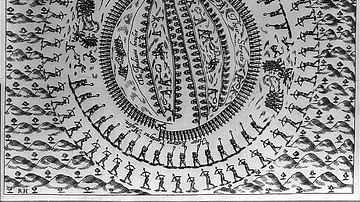
Mystic Massacre of 1637
The Mystic Massacre of 1637 (also known as the Pequot Massacre) was the pivotal event of the Pequot War (1636-1638) in New England fought between the English (along with their Native American allies the Mohegan and Narragansett tribes) and...

Image
Robert Clive & The East India Company Rule in India, c. 1765
A map illustrating the transformation of the East India Company from a hopeful merchant venture in 1600 with isolated trade outposts governed by isolated and mostly independent town councils into a major ruler of large territories in India...

Article
Battle of Fleurus
The Battle of Fleurus (26 June 1794) was the climax of the Flanders Campaign of 1792-95 and was one of the most decisive battles in the War of the First Coalition (1792-1797). A French victory, Fleurus ensured French ascendency for the rest...

Image
Map of the ancient Near East during the Amarna Period
Map of the ancient Near East during the Amarna Period, showing the great powers of the period: Egypt (green), Hatti (yellow), the Kassite kingdom of Babylon (purple), Assyria (grey), and Mittani (red). Lighter areas show direct control, darker...
Image
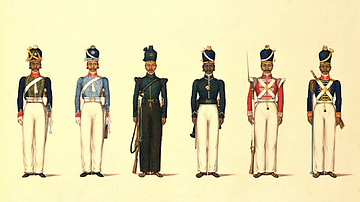
East India Company Madras Uniforms
A c. 1830 illustration by Yellapah of Vellore showing six Sepoy uniforms of the East India Company Madras army. From left to right: - Madras Horse Artillery - Madras Light Cavalry - Madras Rifle Corps - Madras Pioneers - Madras...
Image
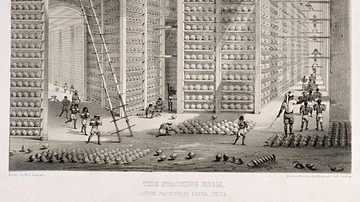
Opium Warehouse of the East India Company
A c. 1850 print showing an opium warehouse of the East India Company in Patna, India. Opium was dried into large balls and then packed into chests for transportation to China.
Image
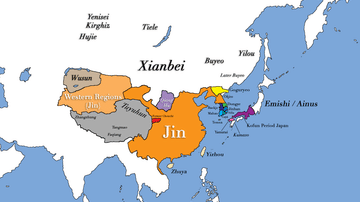
East Asia circa 300 CE
This map shows all major civilizations of East Asia at the beginning of the 3rd century CE. Italicized texts indicate nomadic bands or tribal societies.

Image
East Asia in the year 1 CE
This map shows the boundaries of all major civilizations in East Asia at the beginning of the first millennium, with italics indicating nomadic bands and other tribal societies.
