
Search
Remove Ads
Advertisement
Search Results

Video
Norse Mythology: an Introduction to the Norse Gods, Goddesses, Myths and Legends
Norse mythology was the belief of the people of Scandinavia around the Viking age between around 790 and 1100 CE. It consisted of cosmology or story of the beginning of the universe...

Video
A Short History of Assyria and the Neo-Assyrian Empire
Assyria has a long history, beginning in northern Mesopotamia and then expanding during the Neo-Assyrian Empire from Mesopotamia through Asia Minor, and down through Egypt. The empire began in the...
Definition
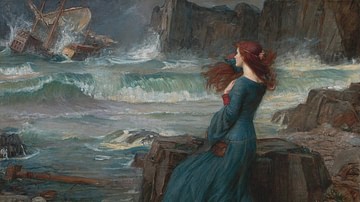
The Tempest - Shakespeare's Magical Tragicomedy
The Tempest is a play by William Shakespeare (c. 1564-1616), written in 1610 or 1611, and first performed for the court of James I of England (r. 1603-1625) on 2 November 1611. Believed to be the last play...

Definition
Pequot War
The Pequot War (1636-1638) was a conflict between the Native American Pequot tribe and the English immigrants who had established settlements in New England between 1620-1630. The immediate cause of the war was the murder of two English...

Video
Athena the Greek Goddess of Wisdom, War and the Crafts
Athena was the Greek goddess of wisdom, war, strategy, the crafts and weaving, and the defence of towns. She was a resourceful goddess, a favourite of her father Zeus, and often provided good counsel...

Video
Unveiling Slavic Myths - A Conversation With Noah And Svetlana
Slavic cultures are far-ranging, comprising East Slavs (Russia, Ukraine, Belarus), West Slavs (Czech Republic, Slovakia, Poland) and South Slavs (the countries of former Yugoslavia plus Bulgaria...

Video
Ancient Celtic Religion, Druids and Funerary Beliefs
The Ancient Celtic religion was a polytheistic one, with numerous gods with sometimes overlapping responsibilities. The ancient Celts, who occupied parts of western and central Europe during the Late...

Video
Hades, Tartarus and the Underworld in Greek Mythology
The Greek God Hades was born to the Titans Rhea and Cronus, and along with his siblings Hestia, Demeter, Hera and Poseidon, they were swallowed by their father (except Zeus). After the battle known...

Video
The Greek Myth of Theseus, Ariadne and the Minotaur
Theseus was the legendary hero-king of Athens who had both mortal and divine lineage as the son of the mortal Aethra of Troezen, and either the god of the sea, Poseidon, or Aegeus the king of Athens...

Definition
Ahriman
Ahriman is the evil spirit in Early Iranian Religion, Zoroastrianism, and Zorvanism, Lord of Darkness and Chaos, and the source of human confusion, disappointment, and strife. He is also known as Angra Mainyu (evil spirit or dark spirit...
