
Search
Remove Ads
Advertisement
Search Results

Definition
Amphora
An amphora (Greek: amphoreus) is a jar with two vertical handles used in antiquity for the storage and transportation of foodstuffs such as wine and olive oil. The name derives from the Greek amphi-phoreus meaning 'carried on both sides'...

Definition
Miltiades
Miltiades (c. 555-489 BCE) was the Athenian general who defeated the Persians at the Battle of Marathon in 490 BCE. The Greeks faced a Persian force of superior numbers led by the commanding admiral Datis, who had been sent by their...

Definition
Ancient Celts
The ancient Celts were various tribal groups living in parts of western and central Europe in the Late Bronze Age and through the Iron Age (c. 700 BCE to c. 400 CE). Given the name Celts by ancient writers, these tribes and their...

Definition
Khaemweset
Khaemweset (also given as Khaemwaset, Khaemwise, Khaemuas, Setem Khaemwaset, c. 1281-c.1225 BCE) was the fourth son of Ramesses II (1279-1213 BCE) and his queen Isetnefret. He is the best known of Ramesses II's many children after...

Definition
Homo Naledi
Homo naledi is an extinct species of human discovered in Rising Star Cave in South Africa in 2013 CE in what has become the biggest single-species hominin find in Africa to this day, which is moreover set to cause a bit of an avalanche...
Definition
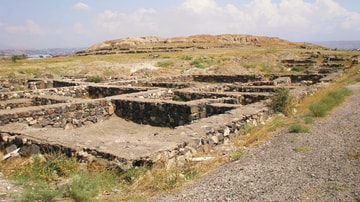
Teishebaini
Teishebaini (aka Tesebaini, modern Karmir-Blur, near Yerevan, Armenia) was an important fortress city of the Urartu civilization and excavations at the site, largely undisturbed since its abandonment c. 590 BCE, have provided an invaluable...

Definition
Bayeux Tapestry
The Bayeux Tapestry shows in pictures the events leading up to the Norman conquest of England by William the Conqueror, Duke of Normandy, and his 1066 defeat of King Harold Godwinson at the Battle of Hastings. It was produced...

Definition
Mehmed II
Mehmed II (1432-1481 CE), also known as Mehmed the Conqueror, was the seventh and among the greatest sultans of the Ottoman Empire. His conquests consolidated Ottoman rule in Anatolia and the Balkans, and he most famously triumphed...

Definition
Hyperborea
In Greek mythology, Hyperborea was the land located to the far north of the known world and it was so remote it was considered even beyond the North Wind. There a legendary race known as the Hyperboreans lived and worshipped the sun...

Definition
Ludwig van Beethoven
Ludwig van Beethoven (1770-1827) was a German composer of Classical and Romantic music; he is widely regarded as one of the greatest musicians to have ever lived. Most famous for his nine symphonies, piano concertos, piano...
