
Search
Remove Ads
Advertisement
Search Results

Article
Ten Great Native American Mound Sites
The Native Americans of Pre-Colonial North America built thousands of mounds across the continent which served various purposes and sometimes reached heights over 100 feet. Many of the mound sites were thriving...

Definition
Hercules
Hercules (Herakles) was a hero of Greek mythology famous for his great strength and endurance. Celebrated as an extraordinary mortal, his success in seemingly impossible labours won him an immortal place amongst the gods. As the greatest...
Definition
Macrinus
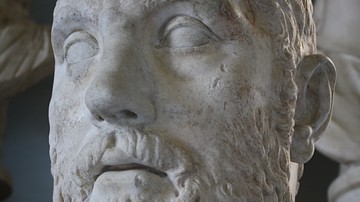
Macrinus was Roman emperor from April 217 to June 218 CE. It is a story that has been told countless times before - an emperor is assassinated leaving no heir or successor. On April 8, 217 CE Roman Emperor Caracalla was murdered, supposedly...

Definition
Mycenaean Civilization
The Mycenaean civilization flourished in the Late Bronze Age (c. 1700-1100 BCE), peaking from the 15th to the 13th century BCE. The Mycenaeans extended their influence throughout the Peloponnese in Greece and across the Aegean...

Definition
Roman Britain
Britain was a significant addition to the ever-expanding Roman Empire. For decades, Rome had been conquering the Mediterranean Sea – defeating Carthage in the Punic Wars, overwhelming Macedon and Greece, and finally marching into...

Definition
Mandala
A mandala (Sanskrit for “circle”) is an artistic representation of higher thought and deeper meaning given as a geometric symbol used in spiritual, emotional, or psychological work to focus one's attention. The image first appears in...

Definition
Francisco Pizarro
Francisco Pizarro (c. 1478-1541) was a conquistador who led the Spanish conquest of the Inca civilization from 1532. With only a small group of men, Pizarro took advantage of his superior weapons and the fact that the Incas were...

Definition
Pluto
Pluto is the god of the Underworld in Roman mythology. His Greek counterpart was Hades. Pluto chose never to sit on Olympus with the other gods and goddesses, preferring to remain in the Underworld. Family Pluto (Hades) was the son...

Definition
Hurrians
The Hurrians (aka Hurri or Khurri) were a Bronze Age people who flourished across the Near East from the 4th millennium BCE to the 1st millennium BCE. Hurrian is also the name of the language these people spoke and, indeed, is the one...

Definition
Arminius
The Cherusci noble Arminius (c. 18 BCE - 19 CE) led the resistance to Roman conquest of Germania during the years 9-16 CE. Likely raised as a child hostage in Rome, Arminius gained command of a German auxiliary cohort in the Roman army...
