
Search
Remove Ads
Advertisement
Search Results

Image
Donation of Constantine
Sylvester I (served 315-335 CE) and Constantine the Great (r. 306-337 CE), San Silvestro Chapel at Santi Quattro Coronati, Rome.
Image
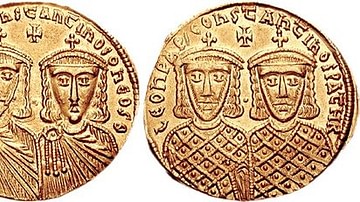
Leo IV & Constantine VI
A gold coin depicting Byzantine emperor Leo IV (r. 775-780 CE) on the right and his son and successor Constantine VI (r. 780-797 CE) on the left. (Classical Numismatic Group, Inc. http://www.cngcoins.com)
Image
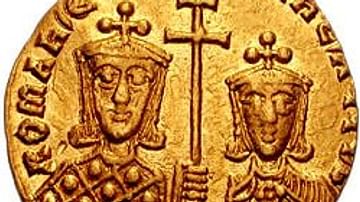
Constantine VII & Romanos II
A gold Byzantine nomisma coin depicting Emperor Constantine VII (r. 945-959 CE) and his son and successor Romanos II (r. 959-963 CE).
Image
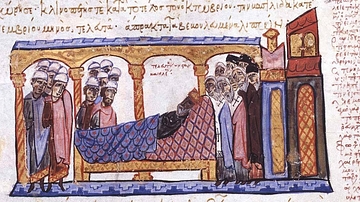
Dying Constantine VII
A 12th century CE illustration of Byzantine emperor Constantine VII on his deathbed (r. 945-959 CE). From the Madrid Skylitzes. (National Library, Madrid)

Image
Constantine X Doukas
Constantine X Dukas. Byzantine Emperor, r. 1059-1067 CE.
Gold Histamenon (4.33 gm, 6h). Constantinople mint.

Definition
Mehmed II
Mehmed II (1432-1481 CE), also known as Mehmed the Conqueror, was the seventh and among the greatest sultans of the Ottoman Empire. His conquests consolidated Ottoman rule in Anatolia and the Balkans, and he most famously triumphed...

Video
A Day in the Life of a Teenage Samurai - Constantine N. Vaporis
Follow Mori Banshirô, a young samurai in training, as he studies the twin paths of literary learning and the martial arts. — The year is 1800 in the castle town of Kôchi, Japan. It's...

Article
The Ideal of Christendom in Antiquity
The ideal of Christendom is a historical and political vision where society and government are unified under the Christian faith. According to this vision, power on Earth is divided between the church through...

Article
1453: The Fall of Constantinople
The city of Constantinople (modern Istanbul) was founded by Roman emperor Constantine I in 324 CE and it acted as the capital of the Eastern Roman Empire, or Byzantine Empire as it has later become known, for well...

Article
Capitals of the Roman Empire: Constantinople & Rome
Constantinople at first had much in common with the temporary capitals of the 2nd and 3rd century CE and the tetrarchic capitals. It was an existing city of medium size, well located on the road network...
