
Search
Remove Ads
Advertisement
Search Results

Definition
Mystras
The city of Mystras (or Mistras) in southern Greece was the provincial capital of the Byzantine Despotate of the Morea from the 13th through the 15th centuries CE. It was founded in 1249 CE by William II of Villehardouin, and it served...
Image
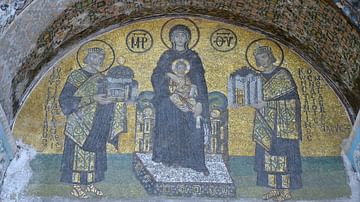
Mosaic with the Virgin Mary, Constantine and Justinian, Hagia Sophia
Mosaic panel located at the southwestern entrance of the basilica Hagia Sophia (Istanbul) depicting the emperor Constantine I holding a model of the city of Constantinople (right), the...

Image
Constantine I
The colossal bronze head from a statue of Constantine I, 4th century CE. The head is 1.77 m high. (Capitoline Museums, Rome).

Image
Arch of Constantine I
The north side of the Arch of Constantine I in Rome. Dedicated in 315 CE, the triumphal arch celebrates the emperor's victory over the Roman tyrant Maxentius in 312 CE. It is the largest surviving triumphal arch and the last...
Image
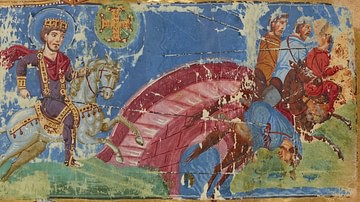
Constantine's Vision
Constantine I's (r. 306-337 CE) vision and the Battle of the Milvian Bridge in a 9th-century Byzantine manuscript. Detail from folio 440 recto of manuscript BnF MS Gr510, dated 879-883 and containing the homilies of Gregory...

Image
Emperor Constantine
A statue of the Roman Emperor "Constantine the Great" who reigned from approximately 306 to 337 CE.

Image
Colossal Bronze Hand of Constantine I
A hand from the colossal bronze statue of Roman emperor Constantine I, 4th century CE. The hand is over 1.5 m in length. (Capitoline Museums, Rome).
Image
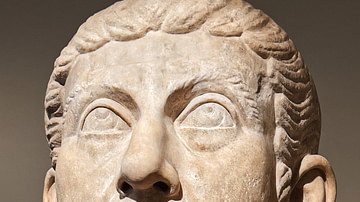
Marble Head of Emperor Constantine I
Marble head of Emperor Constantine I (r. 306-337 CE) by an unknown artist, c. 325-370 CE.
Metropolitan Museum of Art, New York.
Image
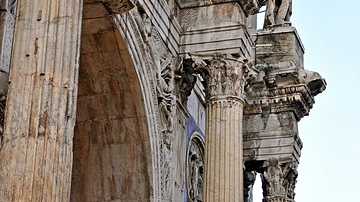
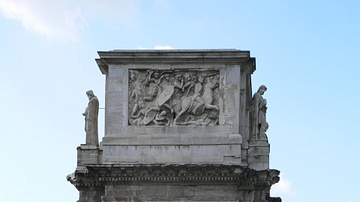
Detail of the Arch of Constantine
A detail of the Arch of Constantine in Rome, built in c. 315 CE to commemorate the Roman emperor's victory over Maxentius in 312 CE. On each side of the arch four free-standing Corinthian columns support statues...
Image
Side View, Arch of Constantine
The Arch of Constantine in Rome, built in c. 315 CE to commemorate the Roman emperor's victory over Maxentius in 312 CE. It is the largest surviving example of a Roman Triumphal Arch.
