
Search
Remove Ads
Advertisement
Search Results
Image
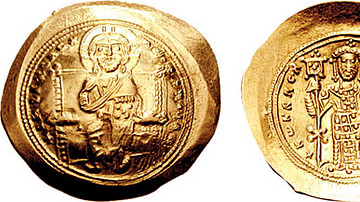
Constantine X Doukas
Constantine X Dukas. Byzantine Emperor, r. 1059-1067 CE.
Gold Histamenon (4.33 gm, 6h). Constantinople mint.
Image
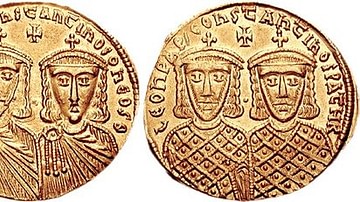
Leo IV & Constantine VI
A gold coin depicting Byzantine emperor Leo IV (r. 775-780 CE) on the right and his son and successor Constantine VI (r. 780-797 CE) on the left. (Classical Numismatic Group, Inc. http://www.cngcoins.com)
Image
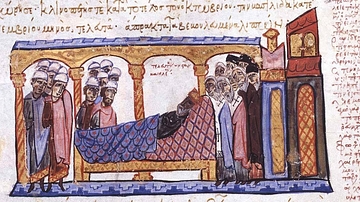
Dying Constantine VII
A 12th century CE illustration of Byzantine emperor Constantine VII on his deathbed (r. 945-959 CE). From the Madrid Skylitzes. (National Library, Madrid)

Article
Six Great Heresies of the Middle Ages
The medieval Church established its monopoly over the spiritual life of Europeans in the Early Middle Ages (c. 476-1000) and consolidated that power throughout the High Middle Ages (1000-1300) and Late Middle...

Video
Arch of Constantine, 315 C.E.
More free lessons at: http://www.khanacademy.org/video?v=mK9y-sPn_AY Arch of Constantine, 315 C.E., Rome Speakers: Valentina Follo, Dr. Beth Harris, Dr. Steven Zucker http://www.smarthistory.org/arch-of-constantine.html...

Definition
Empire of Nicaea
The Empire of Nicaea was a successor state to the Byzantine Empire, or rather a Byzantine Empire in exile lasting from 1204 to 1261 CE. The Empire of Nicaea was founded in the aftermath of the sacking of Constantinople during...
Image
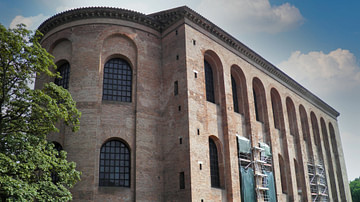
Basilica of Constantine, Trier
The Basilica of Constantine (Aula Palatina) in Trier (Germany) was built around 310 CE by Constantine I (r. 306-337 CE) as the reception and throne room of the imperial palace . With an interior 67 metres (219 ft...

Definition
Michael Psellos
Michael Psellos (1018 - c. 1082 CE) was a Byzantine historian, writer, and intellectual. Michael acted as courtier and advisor to several Byzantine emperors, and he was the tutor of Michael VII. Writing between 1042 and 1078 CE...

Definition
Chrocus
Chrocus (Crocus) was a king of the Alemanni who invaded Roman Gaul c. 256 CE until he was defeated by the Roman legions at Arles and then executed. Conversely, he was a king of the Alemanni who served Rome and supported Constantine the...

Video
Colossus of Constantine
More free lessons at: http://www.khanacademy.org/video?v=MuD06cnjtAM The Colossus of Constantine, c. 312-15, Palazzo dei Conservatori, Musei Capitolini, Rome A conversation between Dr. Beth Harris and Dr. Steven Zucker...
