
Search
Remove Ads
Advertisement
Search Results
Image
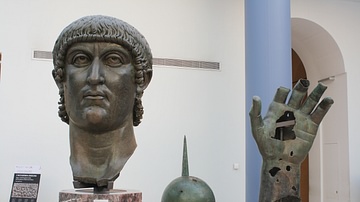
Constantine I Colossus
The head, hand and sphere (symbol of power) from the colossal bronze statue of Constantine I, 4th century CE. The head alone is 1.77 m high. (Capitoline Museums, Rome).
Article
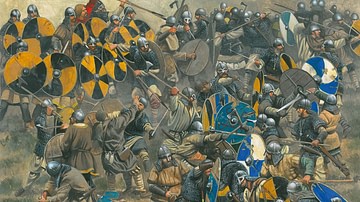
Battle of Brunanburh
The Battle of Brunanburh, fought in the autumn of 937 at an unknown location, saw the English king, Aethelstan (r. 924-939), defeat a coalition of invading armies led by Constantine II of Scotland (r. 900-943) and Olaf Guthfrithson...

Definition
Thessaly and the Duchy of Neopatras
Thessaly was an independent state in medieval Greece from 1267 or 1268 to 1394 CE, first as the Greek-ruled Thessaly and later as the Catalan and Latin-ruled Duchy of Neopatras. Under its sebastokrators, Thessaly...

Definition
Trinity
The Christian doctrine of the Trinity (from the Latin trinus, meaning "threefold") professes that there is one God, but three eternal and consubstantial persons (aspects): the Father, the Son, and the Holy Spirit. The Father is the God...

Video
Forum of Constantine, Byzantium
Forum of Constantine before Constantine's bronze statue fell down during the windstorm in 1106 CE.
Image
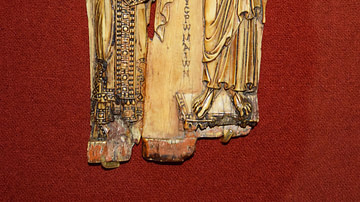
Constantine VII & Christ
This ivory plaque fragment shows Emperor Constantine VII Porphyrogenitus of Byzantium (r. 913-959 CE) being crowned by Jesus Christ. It was carved in royal workshops of Constantinople around 954 CE. (Pushkin Museum, Moscow...

Image
Donation of Constantine
Sylvester I (served 315-335 CE) and Constantine the Great (r. 306-337 CE), San Silvestro Chapel at Santi Quattro Coronati, Rome.

Image
Constantine IV
A 7th century CE mosaic depicting the Byzantine emperor Constantine IV (r. 668-685 CE) and entourage in the basilica of Sant'Apollinare, in Classe, Ravenna, Italy.

Image
Leo III & Constantine V
A gold solidus coin depicting Constantine V, emperor of the Byzantine empire between 741 and 775 CE (right) and Leo III (r. 685-741 CE)
Image
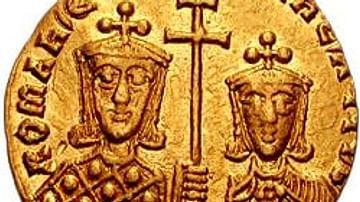
Constantine VII & Romanos II
A gold Byzantine nomisma coin depicting Emperor Constantine VII (r. 945-959 CE) and his son and successor Romanos II (r. 959-963 CE).
