
Search
Remove Ads
Advertisement
Search Results
Definition
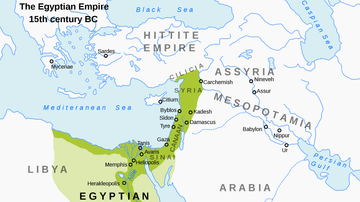
Egyptian Empire
The Egyptian Empire rose during the period of the New Kingdom (c. 1570- c. 1069 BCE), when the country reached its height of wealth, international prestige, and military might. The empire stretched from modern-day Syria in the...

Definition
Kingdom of Nabatea
The Nabatean Kingdom was a powerful political entity which flourished in the region of modern-day Jordan between the 4th century BCE and c. 106 CE and is best known today for the ruins of its capital city of Petra. Although...

Definition
Freyr
Freyr (Old Norse for 'Lord', sometimes anglicised as Frey) is the main fertility god in Norse mythology, his connection with harvests, sun and rain, virility, weddings, and his rule over wealth securing him an important position within...

Definition
Möngke Khan
Mongke Khan was ruler of the Mongol Empire (1206-1368 CE) from 1251 to 1259 CE. As the third Great Khan or 'universal ruler' of the Mongols, Mongke would oversee administrative reforms that continued to centralise government and ensure...

Definition
Ottoman Empire
The Ottoman Sultanate (1299-1922 as an empire; 1922-1924 as caliphate only), also referred to as the Ottoman Empire, written in Turkish as Osmanlı Devleti, was a Turkic imperial state that was conceived by and named after Osman...

Definition
Tiamat - The Great Mesopotamian Goddess of Chaos
Tiamat is the Mesopotamian goddess associated with primordial chaos and the salt sea, best known from the Babylonian epic Enuma Elish. In all versions of the myth, following the original, Tiamat always...

Definition
Bible
The Bible takes its name from the Latin Biblia ('book' or 'books') which comes from the Greek Ta Biblia ('the books') traced to the Phoenician port city of Gebal, known as Byblos to the Greeks. Writing became associated with Byblos as...
Definition
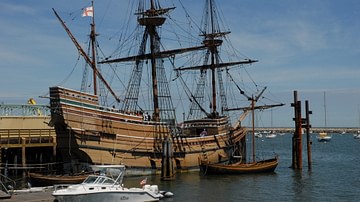
Mayflower
The Mayflower is the name of the cargo ship that brought the Puritan separatists (known as pilgrims) to North America in 1620 CE. It was a type of sailing ship known as a carrack with three masts with square-rigged sails on the main...
Definition
Juvenal
Decimus Junius Juvenalis (l. c. 55-138 CE), better known as Juvenal, was a Roman satirist. He wrote five books, containing 16 satires, each of which criticized a different element of Roman society, whether it was poor housing, the patron/client...

Definition
John Robinson
John Robinson (l. 1576-1625 CE) was the pastor of the Leiden congregation of separatists, some of whom made up the party (later known as pilgrims) who sailed on the Mayflower in 1620 CE to establish the Plymouth Colony in North...
