
Search
Did you mean: Elam?
Remove Ads
Advertisement
Search Results

Image
Clay Cover of the Tablet of Shamash
This is a fired clay cover of the sun god (Shamash) tablet. Its purpose was to protect the obverse side (face) of the tablet. It has retained the impression of the carved panel of the tablet. The Babylonian king...
Image
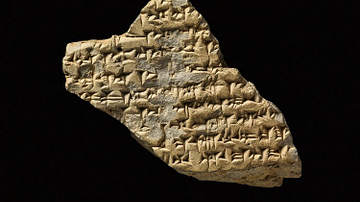
Clay Tablet Inscribed in Hurrian
Inscribed by an unknown author, this portion of a clay tablet comprises eleven lines with a list of gods in Hurrian. It measures 50 mm in height and 49 mm in width. (British Museum, London)
Image
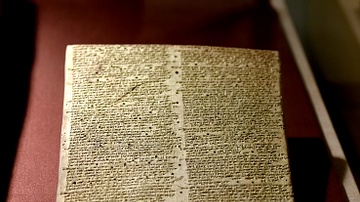
Clay Tablet of Shalmaneser III from Ashur
This clay tablet narrates the building works of the Assyrian king Shalmaneser III (reigned 858-824 BCE). From Ashur (Assur), Iraq. (The Iraq Museum, Baghdad).
Image
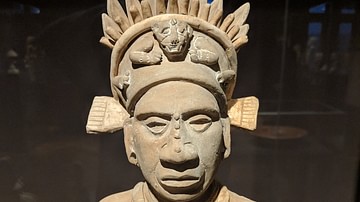
Clay Maya Nobleman Figure
Maya Nobleman, Jaina, Maya culture, Late Classic Period, c. 600-900 CE. Campeche, Mexico. Fired clay with remnants of paint.
Exhibited at Museum Rietberg, Zurich, Switzerland.
Image
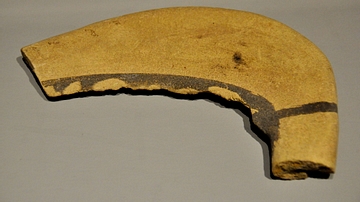
Clay Sickle
This cutting tool witnessed the beginning of agriculture. Ubaid period, 5th millennium BCE, Mesopotamia, Iraq. (The Sulaimaniya Museum, Iraq).
Image
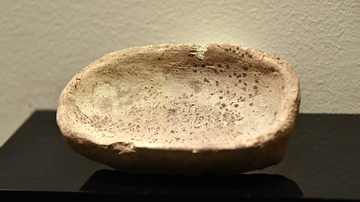
Clay Mold for Casting Copper
Such molds appeared for the very first time during the late Chalcolithic period. Their use indicates a trend towards mass production and consumption of copper goods. Late Chalcolithic period, 4000-3600 BCE. From Hujayrat...
Image
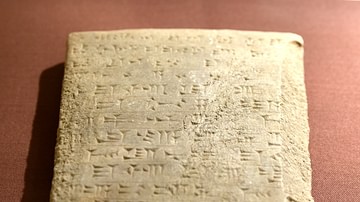
Clay Tablet of Adad-Nirari II from Assur
Cay tablet narrating the building works of the Assyrian king Adad-Nirari II (r. 911-891 BCE), from Ashur (Assur), modern-day Iraq.
The Iraq Museum, Baghdad.
Image
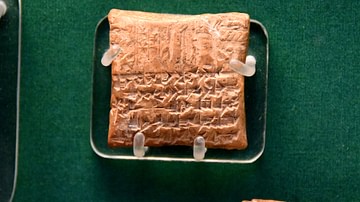
Clay Tablet from Alalakh with Idrimi's Seal
Agreement for annual dues of gold and sheep to be paid to the King, either Idirimi or his son Niqmepa, who often used his father's seal. The seal's inscription reads "Idrimi, servant of the god Adad". 1500-1450...
Image
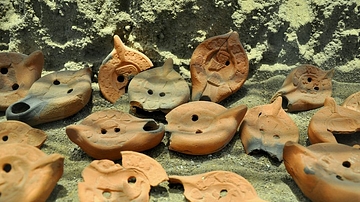
Clay Lamps
Urban Archaeology and the Museum of Rome in the Middle Ages The contexts of the Crypta are integrated by coeval finds coming from the historical collections of the Roman museums and by the contexts unearthed during the urban excavations...

Image
Henry Clay Speaks in Favor of the Compromise of 1850
Henry Clay (1777-1852), the Great Compromiser, takes the Senate floor one final time to present the Compromise of 1850, drawn by P. F. Rothermel, engraved by R. Whitechurch, published circa 1855...
