
Search
Did you mean: Elam?
Remove Ads
Advertisement
Search Results
Image
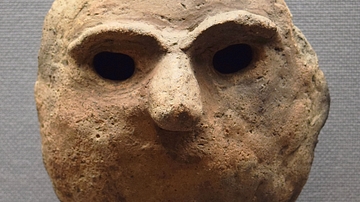
Prehistoric Domen Clay Mask
This prehistoric domen clay mask is from Kami Hata in Nagano, Japan. It dates from the Jomon period or roughly from 2000-1000 BCE. (Tokyo National Museum)

Image
Death of Henry Clay Jr.
Death of Henry Clay Jr., son of the 'Great Compromiser', at the Battle of Buena Vista. By N. Currier, 1847.
Beinecke Rare Book & Manuscript Library at Yale University.
![Illegally Excavated Mesopotamian Clay Tablet [13]](https://www.worldhistory.org/img/c/p/360x202/7090.jpg?v=1618722902)
Image
Illegally Excavated Mesopotamian Clay Tablet [13]
This clay tablet was illegally excavated. The precise provenance of the excavation is unknown, but probably from Southern Mesopotamia, modern-day Iraq. It is currently housed in the Sulaymaniyah Museum...
![Illegally Excavated Mesopotamian Clay Tablet [2]](https://www.worldhistory.org/img/c/p/360x202/7098.jpg?v=1771874968)
Image
Illegally Excavated Mesopotamian Clay Tablet [2]
This clay tablet was illegally excavated. The precise provenance of the excavation is unknown, but probably from Southern Mesopotamia, modern-day Iraq. It is currently housed in the Sulaymaniyah Museum...
Image
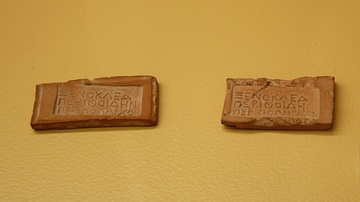
Greek Clay Passport Tokens
Clay tokens probably used as passports by travellers or messengers reporting between military headquarters. Belonging to Xenokles, a border commander, 4th century BCE. (Agora Museum, Athens)
![Illegally Excavated Mesopotamian Clay Tablet [4]](https://www.worldhistory.org/img/c/p/360x202/7099.jpg?v=1771874971)
Image
Illegally Excavated Mesopotamian Clay Tablet [4]
This clay tablet was illegally excavated. The precise provenance of the excavation is unknown, but probably from Southern Mesopotamia, modern-day Iraq. It is currently housed in the Sulaymaniyah Museum...
![Illegally Excavated Mesopotamian Clay Tablet [3]](https://www.worldhistory.org/img/c/p/360x202/7101.jpg?v=1771874964)
Image
Illegally Excavated Mesopotamian Clay Tablet [3]
This clay tablet was illegally excavated. The precise provenance of the excavation is unknown, but probably from Southern Mesopotamia, modern-day Iraq. It is currently housed in the Sulaymaniyah Museum...
![Illegally Excavated Mesopotamian Clay Tablet [9]](https://www.worldhistory.org/img/c/p/360x202/7102.jpg?v=1599475503)
Image
Illegally Excavated Mesopotamian Clay Tablet [9]
This clay tablet was illegally excavated. The precise provenance of the excavation is unknown, but probably from Southern Mesopotamia, modern-day Iraq. It is currently housed in the Sulaymaniyah Museum...

Image
Illegally Excavated Mesopotamian Clay Tablet
This clay tablet was illegally excavated. The precise provenance of the excavation is unknown, but probably from Southern Mesopotamia, modern-day Iraq. It is currently housed in the Sulaymaniyah Museum...

Image
End View, Illegally Excavated Mesopotamian Clay Tablet
This clay tablet was illegally excavated. The precise provenance of the excavation is unknown, but probably from Southern Mesopotamia, modern-day Iraq. It is currently housed in the Sulaymaniyah...
