
Search
Did you mean: Elam?
Remove Ads
Advertisement
Search Results

Image
Chunkey Player Flint Clay Figurine from Cahokia
The Chunkey Player Effigy Pipe (also known as "The Chunkey Player"), made of flint clay, measuring 8.5 inches (22 cm) high by 5.5 inches (14 cm) wide. Thought to have originally come from Cahokia but found...
Image
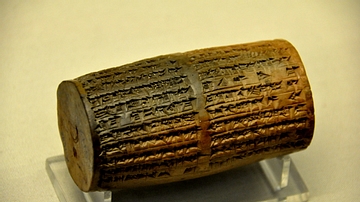
King Nabonidus Clay Cylinder from Ur
This clay document tells us how Nabonidus (the last king of Babylon) built and reconstructed the temple of Sin, the moon God, at Ur. It also mentions a prayer for the king and Beslshazzar, his son. From Ur, neo-Babylonian...
Image
Geometric-Algebraic Theory Clay Tablet from Tell al-Dhabba'i
This clay tablet narrates a geometric-algebraic theory of how to make a solution for a mathematical problem. The conclusion applies a theory very similar to the Pythagorean theorem. From Tell...
Image
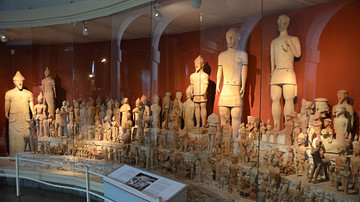
Cypriot Votive Clay Figurines
Votive clay figurines found in situ in the sanctuary of Agia Irini on the northwest coast Cyprus. Dating back to the 7th and 6th centuries BCE, the figurines are displayed in the Cyprus Museum as they were found and...
Image
Foundation Clay Tablet from Larsa
This clay tablet records the restoration of the temple of the sun god Shamash at Larsa (modern-day Sankarah or Tell as-Senkereh) by King Hammurabi. Old Babylonian Period, reign of Hammurabi, 1792-1750 BCE. From Larsa...

Image
Jomon Clay Mask
A Jomon clay mask or domen. Kidukuri, Kamegaoka, Tsugaru-shi, Aomori, Japan. Jomon Period, 1000-400 BCE. Important Cultural Property. (Tokyo National Museum)
Image
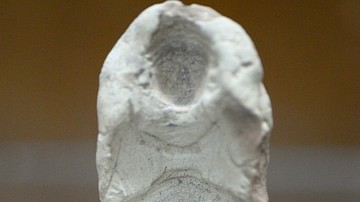
Woman's Figurine Clay Mold
Clay mold which was used for making a woman's figurine. The woman is naked and she stands and holds her breasts by her hands. From Mesopotamia, modern-day Iraq. Old Babylonian period, 2003-1959 BCE. The Sulaymaniyah Museum...
Image
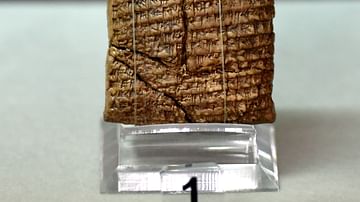
Geometric-Algebraic Theory Clay Tablet from Tell Harmal
This clay tablet narrates a geometric-algebraic theory of angles and triangles, similar to to the theory of Euclid of Alexandria, the father of geometry (lived c. 300 BCE). From Tell Harmal (ancient...
Image
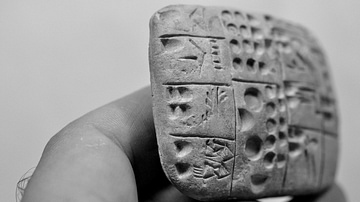
Side View, Illegally Excavated Mesopotamian Clay Tablet
This clay tablet was illegally excavated. The precise provenance of the excavation is unknown, but probably from Southern Mesopotamia, modern-day Iraq. It is currently housed in the Sulaymaniyah...
Image
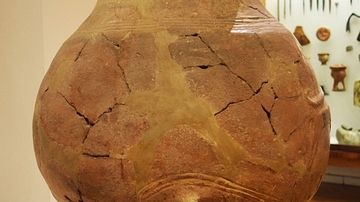
Ancient Clay Vessel from Georgia
This very large clay vessel was unearthed in Zhinvali, Georgia and dates from the first half of the 3rd millennium BCE. (Georgian National Museum, Tbilisi)
