
Search
Remove Ads
Advertisement
Search Results
Image
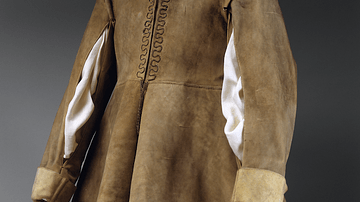
English Buff Coat for Cavalry
A typical buff coat worn by cavalry in the English Civil Wars (1642-51). The thick leather was much lighter than armour but could protect against sword slashes. (Metropolitan Museum of Art, New York)
Image
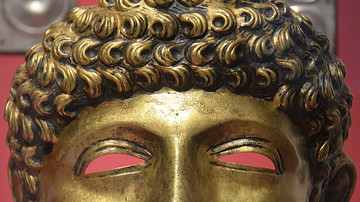
Golden Cavalry Face Mask
Golden Cavalry Face-Mask Helmet (Type Ribchester) dating from 80-125 CE, found on the bed of the Corbulo Canal (Fossa Corbulonis) near the Roman fort of Matilo (modern Leiden). (Rijksmuseum van Oudheden, Leiden, Netherlands...

Image
Mahdist Cavalry Charge, Omdurman
An illustration by Robert Talbot Kelly showing a Mahdist camel cavalry charge against the Anglo-Egyptian-Sudanese lines at the Battle of Omdurman on 2 September 1898 during the Mahdist War (1881-99).

Image
Cavalry Face-Mask Helmet
Cavalry Face-Mask Helmet (Type Nijmegen-Kops Plateau), brass sheet on iron core, dating to the 1st or 2nd century CE. (Rijksmuseum van Oudheden, Leiden, Netherlands)
Image
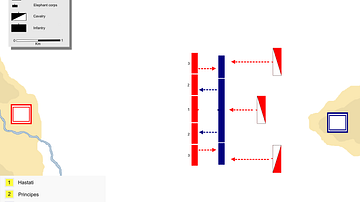
The Battle of Zama - Cavalry Charge
The Battle of Zama (202 BCE). Scipio and Hannibal rearrange their troops in a single line and battle remains stalemate until Roman cavalry returns and attacks Hannibal's infantry at the rear.
Image
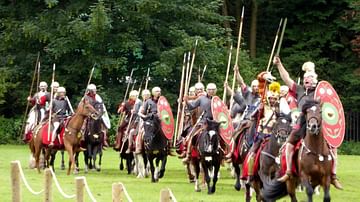
Roman Cavalry Turma Reenactors
Reenactors at Hadrian's Cavalry Turma! Bitts Park, 2017.

Interview
Rubin Museum's Faith and Empire: Tibetan Buddhist Art
Faith and Empire: Art and Politics in Tibetan Buddhism, a new exhibition at the Rubin Museum of Art in New York, explores the dynamic historical intersection of politics, religion, and art as reflected...
Image
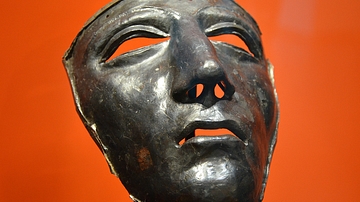
Kalkriese face mask for Roman cavalry helmet
This military face mask is one of the most exceptional finds at the Kalkriese battle grounds. As 'The Kalkriese Type' it stands as the prime example for masks with a small face, the eyes are not particularly...

Image
English Civil War Cavalry
Members of the Sealed Knot, a British re-enactment group of the English Civil Wars (1642-51).

Collection
Chinese Philosophy
Ancient Chinese Philosophy developed during the Spring and Autumn Period (c. 772-476 BCE) and the Warring States Period (c. 481-221 BCE) in ancient China. This was the era known as the Hundred Schools of Thought, referring to...
