
Search
Remove Ads
Advertisement
Search Results

Definition
Zhou Dynasty
The Zhou Dynasty (1046-256 BCE) was among the most culturally significant of the early Chinese dynasties and the longest lasting of any in China's history, divided into two periods: Western Zhou (1046-771 BCE) and Eastern Zhou (771-256...

Definition
Parthian Warfare
Parthian warfare was characterized by the extensive use of cavalry and archers. Coming at enemy troops from all directions Parthian riders created confusion and wreaked havoc. They even developed the famous “Parthian shot.” Able...

Article
Daily Life in Ancient China
Daily life in ancient China changed through the centuries but reflected the values of the presence of gods and one's ancestors in almost every time period. Villages like Banpo show evidence of a matriarchal society, where...

Article
Fortifications in Ancient Chinese Warfare
While ancient Chinese warfare was often characterised by large armies in pitched battles, siege warfare and the sacking of cities were also regular features. Huge earth walls with towers and encircling ditches...

Article
Mongol Multiculturalism
The Mongol Empire accepted and promoted many other cultures. Historians often talk about cultural exchange across Asia in the Mongol Empire as something that was just facilitated by peace and stability across such a huge...

Definition
Ancient China
Ancient China produced what has become the oldest extant culture in the world. The name 'China' comes from the Sanskrit Cina (derived from the name of the Chinese Qin Dynasty, pronounced 'Chin') which was translated as 'Cin' by...

Article
The Dragon in Ancient China
Dragons appear in the mythology of many ancient cultures but nowhere else in the world was the creature quite so revered as in China. There, in marked contrast to other world mythologies, the dragon was almost always...
Article
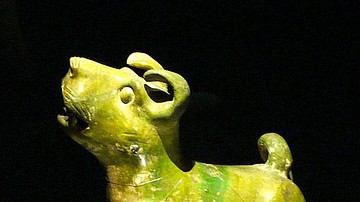
Dogs in Ancient China
Dogs are the oldest domesticated animal in China and were bred as guardians, for transporting goods, for herding, hunting, and as a food source. Archaeological evidence dates the domestication of the dog in China at approximately...

Article
The Battle of Pharsalus
Pharsalus, in eastern Greece, was the site of a decisive battle in 48 BCE between two of Rome's greatest ever generals: Pompey the Great and Julius Caesar. After several previous encounters, Pharsalus, the biggest ever battle...

Definition
Battle of Thymbra
The Battle of Thymbra (547 BCE) was the decisive engagement between Cyrus II (the Great, r. c. 550-530 BCE) of Persia and Croesus (r. 560-546 BCE), King of Lydia. The Persian victory ended the Kingdom of Lydia, which was then...
