
Search
Remove Ads
Advertisement
Search Results

Definition
Khitan
The Khitan people formed the Liao dynasty and ruled parts of Mongolia, Manchuria, and northern China from 907 to 1125 CE. Adopting elements of Chinese government and culture, the Khitan were more than a match for their rivals the Song...

Article
The Seven Voyages of Zheng He
Admiral Zheng He (aka Cheng Ho, c. 1371-1433 CE) was a Chinese Muslim eunuch explorer who was sent by the Ming dynasty emperor Yongle (r. 1403-1424 CE) on seven diplomatic missions to increase trade and secure tribute...

Image
Norman Cavalry at Hastings, Bayeux Tapestry
A scene from the 11th century CE Bayeux Tapestry showing the Battle of Hastings in 1066 CE. (Centre Guillaume le Conquérant, Bayeux, France)

Image
Ottoman Sipahi Cavalry
16-17 century CE Ottoman sipahis in battle at Vienna, holding the crescent banner (by Józef Brandt)

Image
Gustavus Adolphus Leading a Cavalry Charge
A 17th-century painting by Jan Martszen de Jonge showing the Swedish king Gustavus Adolphus (r. 1611-1632) in battle.
Image
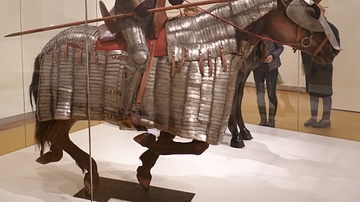
Mamluk or Ottoman Cavalry
Armour for a cavalryman and his horse, produced c. 1500 CE. From the Mamluk Sultanate or Ottoman Empire. Collection of the Hermitage Amsterdam.
Image
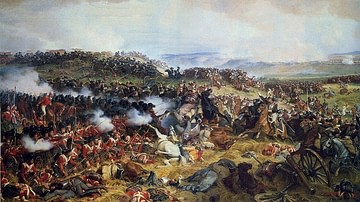
British Squares Halt the French Cavalry Charge at Waterloo
The Battle of Waterloo: The British Squares Receiving the Charge of the French Cuirassiers (18 June 1815), oil on canvas by Henri Félix Emmanuel Philippoteaux, 1874. Victoria and Albert Museum...

Definition
Yongle Emperor
The Yongle Emperor (aka Chengzu or Yung Lo, r. 1403-1424 CE) was the third ruler of the Chinese Ming Dynasty (1368-1644 CE). Inheriting a stable state thanks to the work of his father, the Hongwu Emperor (r. 1368-1398 CE), Yongle...

Definition
Sima Qian
Sima Qian (l. 145/135-86 BCE) was a court scribe, astrologer, and historian of the Han Dynasty (202 BCE - 220 CE) of ancient China, famous for his historical work Records of the Grand Historian for which he is remembered as the Father...

Article
The Army of Alexander the Great
No military commander in history has ever won a battle by himself. To be successful he needs the support of a well-trained army who will follow him regardless of the cost whether it be a stunning victory or hopeless...
