
Search
Remove Ads
Advertisement
Search Results

Definition
Edo Period
The Edo period refers to the years from 1603 until 1868 when the Tokugawa family ruled Japan. The era is named after the city of Edo, modern-day Tokyo, where the Tokugawa shogunate had its government. It is also sometimes referred...

Definition
Adam Smith
Adam Smith (1723-1790) was a Scottish philosopher, economist, and leading Enlightenment figure. In The Wealth of Nations, he advocates free trade and limited interference in markets by governments, for which he is seen as the founder...

Definition
Banastre Tarleton
Banastre Tarleton (1754-1833) was a British military officer and politician, most famous for his role in the southern campaigns of the American Revolutionary War (1775-1783). In command of an elite unit of Loyalists called the...

Definition
Mexican-American War
The Mexican-American War (1846-1848) was a conflict between the United States and Mexico, sparked by the US annexation of Texas in 1845. Hoping to seize even more territory from Mexico, US President James K. Polk (served 1845-1849...

Definition
Stonewall Jackson - General Lee's Lieutenant
Thomas J. Jackson (1824-1863), better known as Stonewall Jackson, was one of the most famous Confederate generals of the American Civil War (1861-1865). A veteran of the Mexican-American War and a former...

Definition
Alexander the Great
Alexander III of Macedon, better known as Alexander the Great (l. 21 July 356 BCE – 10 or 11 June 323 BCE, r. 336-323 BCE), was the son of King Philip II of Macedon (r. 359-336 BCE) who became king upon his father's death in...

Definition
Caesarion
Ptolemy XV Caesar “Theos Philopator Philometor” (“the Father-loving Mother-loving God”) (c. 47-30 BCE), better known by his unofficial nickname Caesarion or “Little Caesar” in Greek, was the oldest son of Cleopatra VII (69-30 BCE...

Definition
Neo-Assyrian Empire
The Neo-Assyrian Empire (912-612 BCE) was the final stage of the Assyrian Empire, stretching throughout Mesopotamia, the Levant, Egypt, Anatolia, and into parts of Persia and Arabia. Beginning with the reign of Adad Nirari...
Definition
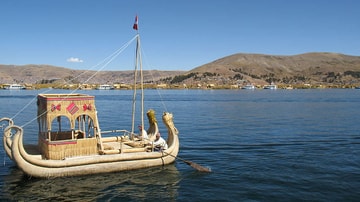
Lake Titicaca
Lake Titicaca is located between Bolivia and Peru and, at an altitude of 3,800 metres (12,500 feet), it is the world's highest navigable lake. The tundra plain known as the altiplano stretches to the south and was the location of...

Definition
Alaric
Alaric I (r. 394-410 CE) was a Gothic military commander who is famous for sacking Rome in 410 CE, which was the first time the city had been sacked in over 800 years. Although little of his family is known, we do know that he became...
