
Search
Remove Ads
Advertisement
Search Results

Definition
Michael II
Michael II the Amorion, also known as Michael “the Stammerer”, was emperor of the Byzantine Empire between 820 and 829 CE. He founded the short-lived Amorion dynasty, named after his hometown in Phrygia, which would last until 867...

Definition
Constantine IV
Constantine IV ruled as emperor of the Byzantine empire from 668 to 685 CE. His reign is best remembered today for the five-year Arab siege of Constantinople from 674 CE, which the Byzantines resisted thanks to their strong fortifications...

Definition
Mongol Empire
The Mongol Empire (1206-1368) was founded by Genghis Khan (r. 1206-1227), first Great Khan or 'universal ruler' of the Mongol peoples. Genghis forged the empire by uniting nomadic tribes of the Asian steppe and creating a devastatingly...

Definition
Europe
Europe is a continent forming the westernmost part of the land mass of Eurasia and comprised of 49 sovereign states. Its name may come from the Greek myth of Europa, but human habitation of the region predates that tale, going back over...

Definition
Fourth Crusade
The Fourth Crusade (1202-1204 CE) was called by Pope Innocent III (r. 1198-1216 CE) to retake Jerusalem from its current Muslim overlords. However, in a bizarre combination of cock-ups, financial constraints, and Venetian trading...

Definition
Golden Horde
The Golden Horde was the European appanage of the Mongol Empire (1206-1368 CE). Begun in earnest by Batu Khan in 1227 CE, the territory that would eventually become the Golden Horde came to encompass parts of Central Asia, much of...

Definition
Batu Khan
Batu Khan (l. 1205-1255 CE) was a grandson of Genghis Khan and the founder of the Golden Horde. Batu was a skilled Mongol military commander and won battles from China to Persia, although his most famous exploits involve the grand...
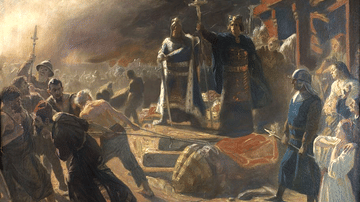
Definition
Slavs
The term "Slavs" designates an ethnic group of people who share a long-term cultural continuity and who speak a set of related languages known as the Slavic languages (all of which belong to the Indo-European language family). Little...

Definition
Byzantine Coinage
The coinage of the Byzantine Empire continued that of its more ancient predecessors and functioned as a convenient method of payment for goods and services, especially to soldiers and officials, and as a means for people to pay...
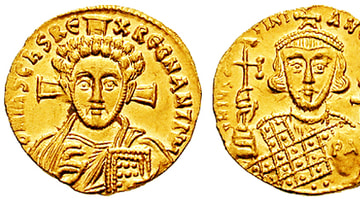
Definition
Justinian II
Justinian II “the Slit-nosed” ruled as emperor of the Byzantine Empire in two spells: from 685 to 695 CE and then again from 705 to 711 CE. It was after his first reign and prior to his exile that his nose was cut off by the usurper...
