
Search
Remove Ads
Advertisement

 This answer was generated by
 Search Results

Image
Khan Krum of the Bulgars
A 15th century CE manuscript illustration depicting the Bulgar Khan Krum (r. c. 802-814 CE) about to receive a drinking cup made from the skull of the Byzantine emperor Nikephoros I (r. 802-811 CE) whose army he had defeated...
Definition
Leo V the Armenian
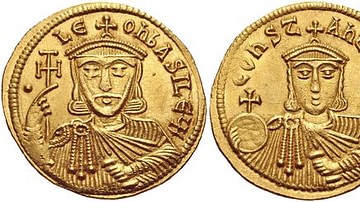
Leo the V the Armenian was emperor of the Byzantine Empire from 813 to 820 CE. He was of Armenian descent and the last ruler of the Isaurian dynasty which had been founded by Leo III (r. 717-741 CE). The emperor's reign, after...

Definition
Nikephoros I
Nikephoros I ruled as emperor of the Byzantine Empire from 802 to 811 CE. A former finance minister who did much to improve the state economy, Nikephoros was not particularly popular with the empire's overtaxed peasants and overregulated...

Definition
Avars
The Avars were a confederation of heterogeneous (diverse or varied) people consisting of Rouran, Hephthalites, and Turkic-Oghuric races who migrated to the region of the Pontic Grass Steppe (an area corresponding to modern-day Ukraine...

Definition
Empress Irene
Empress Irene was the wife of Leo IV and, on her husband's death, she reigned as regent for her son Constantine VI from 780 to 790 CE. From 797 to 802 CE she ruled as emperor in her own right, the first woman to do so in Byzantine...
Definition
Romanos I
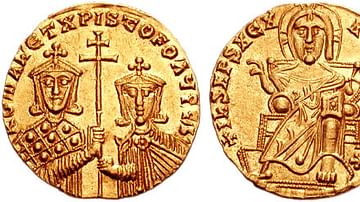
Romanos I Lekapenos (“the Ignorant”) was emperor of the Byzantine Empire from 920 to 944 CE. Of Armenian descent, he was a military commander who usurped the throne to rule as co-emperor with the rightful heir, but still minor, Constantine...

Definition
Leo VI
Leo VI was emperor of the Byzantine empire from 886-912 CE. He was the second emperor of the Macedonian dynasty and is sometimes known as “Leo the Wise” in reference to his prolific literary output which ranged from orations to law codes...

Article
Byzantine-Armenian Relations
The relationship between the Byzantine Empire and ancient Armenia was a constant and varied one with an equal mix of wars, occupations, treaties of friendship, mutual military aid, and cultural exchange. Regarded as...

Image
Map of the First Bulgarian Empire under Simeon the Great
The First Bulgarian Empire under Simeon I the Great (893–927 CE) was the most powerful phase of medieval Bulgaria, shaped by the ruler’s ambition to claim imperial authority rivaling Byzantium...

Definition
Byzantine Empire
The Byzantine Empire existed from 330 to 1453. It is often called the Eastern Roman Empire or simply Byzantium. The Byzantine capital was founded at Constantinople by Constantine I (r. 306-337). The Byzantine Empire varied in...
