
Search
Remove Ads
Advertisement
Search Results

Definition
Leo III
Leo III was emperor of the Byzantine Empire from 717 to 741 CE. He founded the Isaurian dynasty which ruled until 802 CE. The emperor was a talented administrator, and he revamped the empire's political apparatus and legal code. Leo's...
Definition
Empress Zoe - The Great Byzantine Ruler
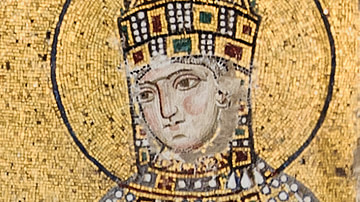
Zoe Porphyrogenita was empress of the Byzantine Empire from 1028 CE until her death in 1050 CE. In an eventful career, she reigned alongside three husbands, had a hand in the succession of her adopted son, and...

Definition
Basil I
Basil I was emperor of the Byzantine Empire from 867 to 886 CE and he founded the "Macedonian" dynasty which lasted for over 200 years. Basil was an Armenian from a humble background who had risen to become the second most powerful man...

Definition
Michael III
Michael III, also known as “Michael the Drunkard” by his detractors, was emperor of the Byzantine Empire from 842 to 867 CE. Never quite escaping the shadow of his mother Theodora, who ruled as regent in his name until c. 855 CE...

Definition
Samo
Samo (reigned 623/624-658 CE) was a king of the Slavs who was responsible for the foundation of the first recorded political entity of the Slavic people, usually referred to as Samo's Empire. Since writing was not introduced into Slavic...

Definition
Anastasios I
Anastasios I ruled the Byzantine empire from 491 to 518 CE. Although his tax and monetary reforms were both popular and successful, the emperor could not repair the damaging split in the Christian Church created by his predecessors...

Article
Society in the Byzantine Empire
The society in the Byzantine Empire (4th-15th century CE) was dominated by the imperial family and the male aristocracy but there were opportunities for social advancement thanks to wars, population movements, imperial...

Article
The Mongol Invasion of Europe
The Mongol invasions of Russia and Eastern Europe occurred first with a brief sortie in 1223 CE and then again in a much larger campaign between 1237 CE and 1242 CE. The Mongols, seemingly coming from nowhere and quickly...

Article
1204: The Sack of Constantinople
In 1204 CE the unthinkable happened and Constantinople, after nine centuries of withstanding all comers, was brutally sacked. Even more startling was the fact that the perpetrators were not any of the traditional...

Image
Map of the Byzantine Empire, c.520 - 1204
This map illustrates the shifting frontiers of the Byzantine Empire from the accession of Justinian I (reign circa 527 - 565) to the Fourth Crusade's sack of Constantinople in 1204, showing how the Greek-speaking...
