
Search
Remove Ads
Advertisement
Search Results
Image
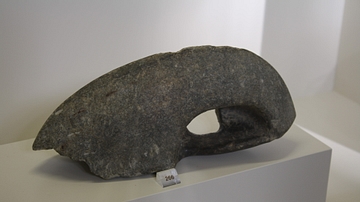
Stone Halter
A jumping weight carried by athletes in each hand in the long jump event to gain distance (date unknown). Olympia Archaeological Museum.

Image
Building Stone from Hadrian's Wall
The inscription "LEG II AVG" is marked both on and below a military standard flanked by a goat and a Pegasus. It records the completion of building work by the 2nd legion Augusta. The Pegasus and Capricorn were...

Image
City Wall of Stone & Opus Caementicium, Roman Empuries (Detail)
A section of the Roman city-wall of Empuries, Spain. 1st century BCE. The base of the wall was made using calcareous rock while the upper portion is of Roman concrete (opus caementicium).
Image
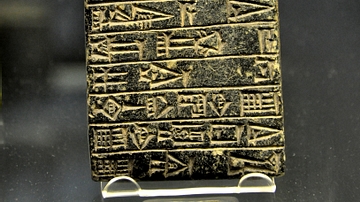
Stone Foundation Tablet of Gudea
This tablet mentions the name of Gudea, ruler of Lagash, to commemorate restoration of the Temple of Nindara. Found below the pavement of the Temple of Nindara at Ur, Southern Mesopotamia, modern-day Iraq. Lagash...
Image
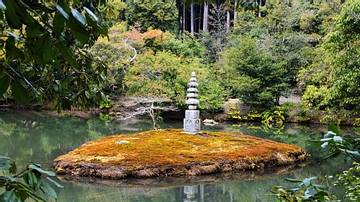
Miniature Stone Pagoda at Kinkakuji Temple
Kinkakuji Temple or the "Temple of the Golden Pavilion" was constructed in the 1390s CE as the retirement palace for Shogun Ashikaga Yoshimitsu (r. 1368–1394 CE). It is surrounded by the waters of a calm pond...
Image
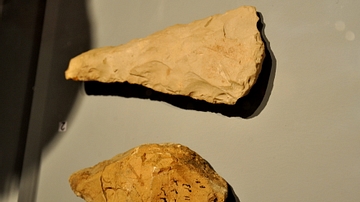
Hand Axe and Stone Tool
These were found in Barda Balka and are considered the oldest human-made artifacts among the whole museum's collections. Circa 100,000 BCE, from Barda Balka (near modern Chamchamal, Sulaimaniya Governorate, Iraq). (The Sulaimaniya...
Image
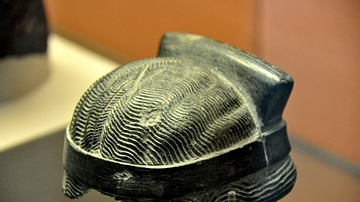
Stone Hair and Headdress of the God Lamma
On the back of this piece, there are cuneiform inscriptions that mention that this headdress was commissioned by a Bau-Ninam on behalf of King Shulgi of Ur. It is most likely that this headdress was to be put...
Image
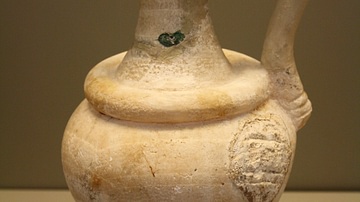
Minoan Stone Jug
A Minoan alabaster jug, Crete, 15th century BCE. (National Archaeological Museum, Athens)

Video
TLALOC (The Aztec god of rain, storms, and fertility)
Made for Ma'am Abi Vilches

Article
The Mesopotamian Pantheon - The Ancient Gods and Goddesses of the Near East
The gods of the Mesopotamian region were not uniform in name, power, provenance or status in the hierarchy. Mesopotamian culture varied from region to region and, because of this...
