
Search
Remove Ads
Advertisement
Search Results

Image
Roman Stone Anchor
A Roman stone anchor from the coast of Saguntum (Sagunto), Spain. 1st century CE. (Archaeological Museum, Sagunto)
Image
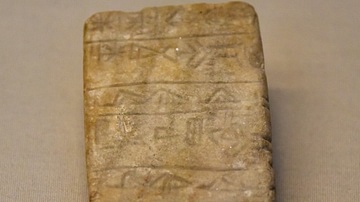
Sumerian Stone Foundation Inscription
It was a Sumerian tradition to deposit or bury objects bearing inscriptions within temples and important public buildings. These recorded the names of the persons who were responsible for the building and also...

Image
Stone Tools at Shengavit Settlement
Stone tools and other archaeological remains from Shengavit, dating from c. 3500-2200 BCE. This settlement is an archaeological site located in Yerevan and is one of Armenia's most important Bronze Age sites.

Image
Viking Rune Stone (Sanda, Sweden)
Top part of a rune stone found at Sanda, Gotland, Sweden, dating to the Viking Age, thought to depict Odin, Thor and Freyr. The runic inscription reads: 'Rodvisl and Farbjörn and Gunbjörn' (The Swedish History Museum/Historiska...

Image
Armenian Stone Weapons Mould
Ancient stone mold, used for making weapons in ancient times in what is present-day Armenia, dating from the 12th-10th century BCE.
Metsamor Historical-Archaeological Museum-Reserve, Taronik.

Image
Olive Press Stone
A stone from an olive press used to collect the oil from the pressed olives and pour it into a waiting receptacle. 6th-2nd century BCE, Saint Blaise, France.
Image
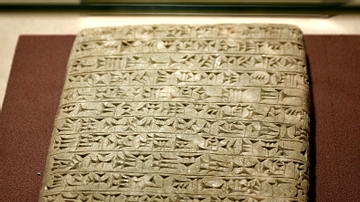
Stone Tablet of Queen Yaba
This stone tablet was found in a niche into the right-hand wall of the space leading to the burial chamber of Tomb II (one of the vaulted burial chambers of the so-called Queens' Tombs inside the North-West Palace at Nimrud...

Image
Utu-Hegal's Stone Monument
The cuneiform inscriptions on this fragment of a stone monument mention the name of Utu-Hegal, King of Uruk. 2125 BCE, from Ur, Mesopotamia, Iraq.
The British Museum, London.
Image
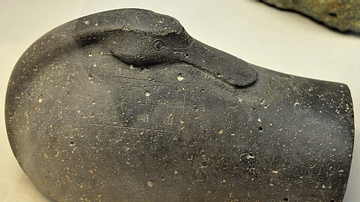
Duck Stone Weight from Nimrud
This stone weight, which weighs 30 minas (about 15 kilograms) was found in the north-west palace at Nimrud (ancient Kalhu), northern Mesopotamia, Iraq. It had been deposited there as booty. Babylonian, reign of Eriba-Marduk...

Image
Carved Stone Showing an Ox
This stone shows an ox; a bullock castrated to make it more docile and easier to control. Oxen were vital to farmers. They were used to pull plows, harrows, and heavy loads. From East Lomond Hill, Scotland, 6th to 8th...
