
Search
Remove Ads
Advertisement
Search Results

Image
Olive Press Stone
A stone from an olive press used to collect the oil from the pressed olives and pour it into a waiting receptacle. 6th-2nd century BCE, Saint Blaise, France.

Image
Utu-Hegal's Stone Monument
The cuneiform inscriptions on this fragment of a stone monument mention the name of Utu-Hegal, King of Uruk. 2125 BCE, from Ur, Mesopotamia, Iraq.
The British Museum, London.
Image
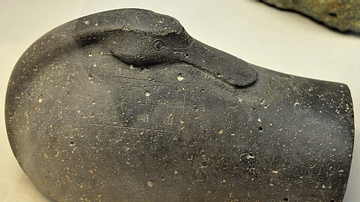
Duck Stone Weight from Nimrud
This stone weight, which weighs 30 minas (about 15 kilograms) was found in the north-west palace at Nimrud (ancient Kalhu), northern Mesopotamia, Iraq. It had been deposited there as booty. Babylonian, reign of Eriba-Marduk...

Image
Carved Stone Showing an Ox
This stone shows an ox; a bullock castrated to make it more docile and easier to control. Oxen were vital to farmers. They were used to pull plows, harrows, and heavy loads. From East Lomond Hill, Scotland, 6th to 8th...

Image
Door Pivot Stone from Girsu
A door pivot stone from Telloh (ancient Girsu), third millennium BCE.
Istanbul Archaeology Museum.
Image
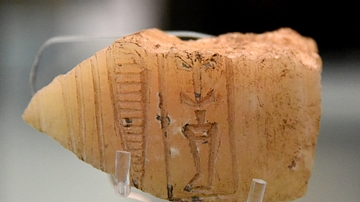
Fragment of Stone Jar Inscribed with the Name of Rimush
This small fragment came from a large upright stone jar. The jar was inscribed with the name of the Akkadian king Rimush, son of Sargon. Akkadian Period, reign of Rimush, 2278-2270 BCE. From Ur...
Image
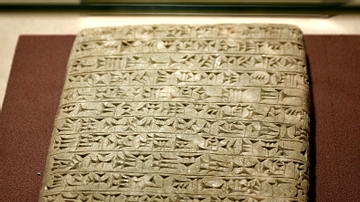
Stone Tablet of Queen Yaba
This stone tablet was found in a niche into the right-hand wall of the space leading to the burial chamber of Tomb II (one of the vaulted burial chambers of the so-called Queens' Tombs inside the North-West Palace at Nimrud...
Image
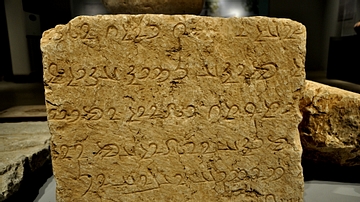
A stone with inscriptions from Paikuli Tower
The inscriptions on this stone mention the name of the Sassanian king Narseh and they were written in middle Persian and Parthian languages. Sassanid period, around 300 CE. From Paikuli tower, modern Sulaimaniya...

Image
A Stone Bowl with Two Inscriptions
This stone bowl has two sets of cuneiform inscriptions. The first one says that the bowl was booty brought to Mesopotamia from Magan (modern Sultanate of Oman) by the Akkadian king Naram-Sin (2254-2218 BCE). The...
Image
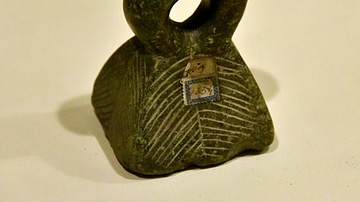
Stone Seal from Gordion
Stone Seal from Gordion (Gordium), the capital city of ancient Phrygia, in modern-day Turkey. First half of the 1st century BCE. (Museum of Archaeology, Istanbul, Turkey).
