
Search
Did you mean: Ares?
Remove Ads
Advertisement

 This answer was generated by
Search Results

Image
Axe-Based Production - Viking Ship Construction 18
At this stage, the saw had almost disappeared from the process of Viking shipbuilding, and production relied mainly on cleaving and axe hewing. Ship planks were made by opening the log along the grain...
Image
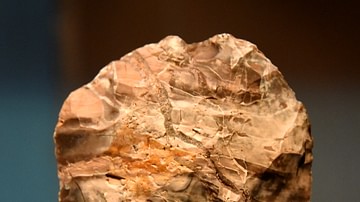
Flint Hand Axe
Paleolithic flint hand axe from modern-day Azraq, Jordan Hashemite Kingdom, 300,000-250,000 years BCE.
The Jordan Museum, Amman, Jordan.
Image
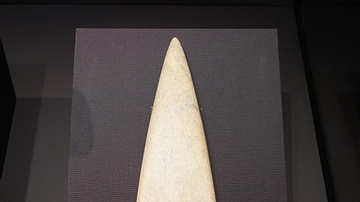
Stone Age Jade Axe
Jade, 5000-3600 BCE. Biebrich, Germany. This axe is made of European jade mined in prehistoric quarries in the Italian Alps. It appears to be an object of beauty rather than function. It would have taken several days to...

Image
Stone Mould for Axes & Bronze Axe from Ancient Ireland
The stone mould, used for making flat and flanged axes, was found at Crannong, Loughscur, Co. Leitrim, Ireland. The bronze axe was found at Lisboy, Co. Meath, Ireland. Both date back to 2500-1700...
Image
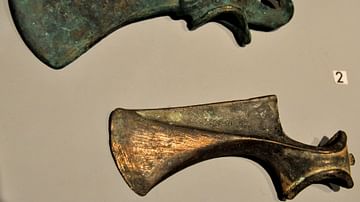
Bronze Shaft-Hole Axe
These two bronze shaft-hole axes date back to the late 3rd millennium BCE, Mesopotamia, Iraq. (The Sulaimaniya Museum, Iraq).

Image
Shaft-Hole Axe from Early Dynastic Period
This shaft-hole axe dates back to the early dynastic period,2800-2350 BCE, Mesopotamia, Iraq. (The Sulaimaniya Museum, Iraq).
Image
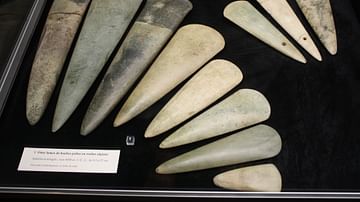
Neolithic Axe Heads
Axe heads of jadeite and eclogite from the neolithic site of Carnac, north-west France. (Archaeological Museum of Carnac)
Image
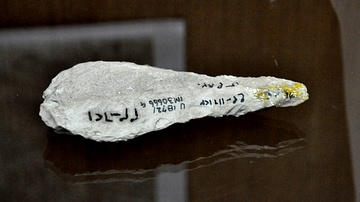
A hand-axe from Hazar Merd Cave
This hand-axe was found in Hazar Merd cave, a paleolithic cave which lies 13 km west of modern Sulaimaniya city, Iraq. It dates back to 50,000 BCE. (The Sulaimaniya Museum, Iraq).
Image
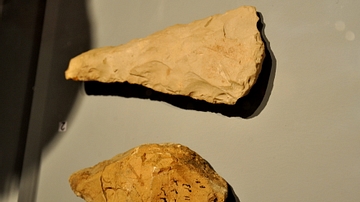
Hand Axe and Stone Tool
These were found in Barda Balka and are considered the oldest human-made artifacts among the whole museum's collections. Circa 100,000 BCE, from Barda Balka (near modern Chamchamal, Sulaimaniya Governorate, Iraq). (The Sulaimaniya...
Image
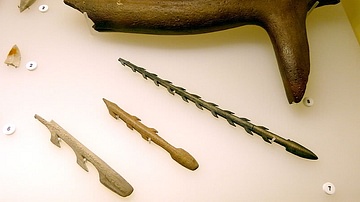
Mesolithic Harpoons & Lyngby Axe
Harpoons and Lyngby Axe (an axe made of antler) dated to around the 11th millennium BCE and belonging to the Mesolithic Age. It is on display at the Archaeological Museum of the state of Brandenburg in Germany.
