
Search
Did you mean: Ares?
Remove Ads
Advertisement
Search Results

Definition
Vulcan
Vulcan or Volcanus was the Roman god of fire and forge, the equivalent of Hephaestus from Greek mythology. The son of Jupiter and Juno, he was the special patron of blacksmiths and artisans. As the god of the forge and the devastating...

Definition
Indra - The Vedic Religion's Greatest God
The anthropomorphic god Indra was the most important god in the Vedic religion and he later became a major figure in Hinduism and an important deity in Buddhism, Cham and Chinese tradition. For the Aryas he...
Definition
Ceide Fields
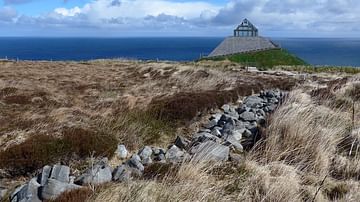
The Ceide Fields, near Ballycastle, Co. Mayo, on the western coast of Ireland, are recognised as one of the oldest and largest Stone Age farming sites in the world, dating back to c. 3700 BCE. The walls that have been discovered...
Definition
Arslan Tash Amulet
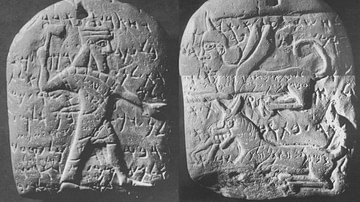
Dated to the 7th century BCE, the Arslan Tash amulet (AT1) was discovered in Arslan Tash, Syria and contains the writing of Phoenician, magic incantations. The limestone plaque includes a variety of features: incantations perceived...
Definition
Vetulonia
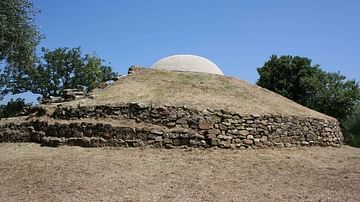
Vetulonia (Etruscan: Vetluna), located in the hills near the western coast of central Italy, was an important Etruscan town from the 9th to 3rd century BCE. The site has many impressive tumulus tombs which were rich in artefacts illustrating...

Image
Minoan Double Axes
Gold votive double axes, New Palace period (1600-1450 BCE), Heraklion Archaeological Museum, Crete.
The double axe, also known as 'labrys', may be the origin of the labyrinth myth of Knossos.

Image
Broad-Bladed Axes - Viking Ship Construction 1
The broad-bladed axe was the Viking shipbuilder’s most important tool, and had been designed to turn oak logs into thin boards. Using these axes instead of a saw preserved the grain structure of the wood...

Article
Battle of Stamford Bridge
The Battle of Stamford Bridge in Yorkshire, England on 25 September 1066 CE saw an army led by English king Harold II (r. Jan-Oct 1066 CE) defeat an invading force led by Harald Hardrada, king of Norway (r. 1046-1066 CE...

Article
Vikings in Wales
The Norse may have ruled parts of northern Wales in the early 11th century, specifically in Anglesey and Gwynedd, though the degree to which is unclear. Old Norse had relatively little impact on Welsh linguistics, and the Old...

Article
Inanna and Ebih - A Poetic Narrative on Feminine Power
Inanna and Ebih is a Sumerian/Akkadian poem attributed to Enheduanna (circa 2300 BCE), daughter of Sargon of Akkad. The work's original title is Inninmehusa ("Goddess of the Fearsome Powers") and...
