
Search
Remove Ads
Advertisement
Search Results

Definition
Wars of the Diadochi
On June 10, 323 BCE Alexander the Great died in Babylon. Although historians have debated the exact cause most agree that the empire he built was left without adequate leadership for there was no clear successor or heir. The...
Definition
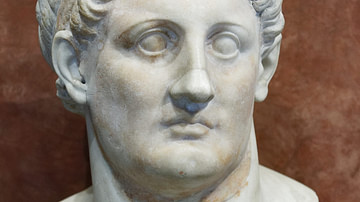
Ptolemy I
Ptolemy I Soter (366-282 BCE) was one of the successor kings to the empire of Alexander the Great. He served not only as king of Egypt but also the founder of the Ptolemaic Dynasty, a dynasty which included the infamous Cleopatra VII...

Definition
Alexander Hamilton
Alexander Hamilton (1755/57-1804) was a lawyer and politician, often recognized as a Founding Father of the United States. He served as George Washington's aide-de-camp during the American Revolution, before going on to become...

Definition
Alexander Selkirk - The Inspiration For Robinson Crusoe
Alexander Selkirk (or Selcraig, 1676-1721) was a Scotsman famously marooned for four years and four months on a desert island in the Pacific Ocean until his rescue by a passing British ship in February...

Image
Arms of Alexander II of Scotland
The arms of Alexander II of Scotland (r. 1214-1249 CE). From folio 146v of Royal MS 14 C VII Historia Anglorum. (British Library, London)

Image
Reverse Side, Seal of Alexander II of Scotland
The reverse side of the Great Seal of Alexander II of Scotland (r. 1214-1249 CE).

Image
Seal of Alexander II of Scotland
The Great Seal of Alexander II of Scotland (r. 1214-1249 CE).

Definition
Cynane
Cynane (l. c. 357- 323 BCE, pronounced `Keenahnay') was the daughter of the Illyrian Princess Audata and King Philip II of Macedon, making her the half-sister of Alexander the Great (l.356-323 BCE). Following the Illyrian tradition of...

Definition
Thessalonike of Macedon
Thessalonike of Macedon (c. 345-295 BCE) was the daughter of Philip II of Macedon (r. 359-336 BCE) and one of his several consorts, Nikesipolis of Pherae (also spelt Nicesipolis). Born to the Argead family of Macedonian...

Definition
Roxanne
After Alexander the Great's victory over King Darius III at the Battle of Gaugamela in 331 BCE, he had to contend with small rebellions that broke out across his empire. In the summer of 328 BCE, one such rebellion occurred in the eastern...
