
Search
Remove Ads
Advertisement
Search Results

Image
Demolition of the Monument to Alexander III in Moscow
Photograph of the demolition of the monument to Alexander III in Moscow, July 1918. As Tsarist Russia fell in 1917, so did the monuments of its monarchs. The colossal bronze statue to Alexander III...

Image
Death of Alexander Clay Tablet
This is a diary of astronomical and meteorological phenomena observed during the 2nd month of the years 323-322 BCE. Written in cuneiform inscription, it records the death of Alexander on the 29th day of the lunar...
Image
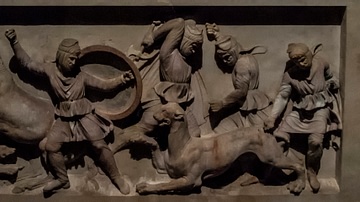
Alexander Sarcophagus
This is a side panel of the Alexander Sarcophagus, a stone sarcophagus adorned with bas-relief carvings of Alexander the Great from the 4th century BCE. Discovered in Sidon, Lebanon and residing in the Istanbul Archaeology...
Image
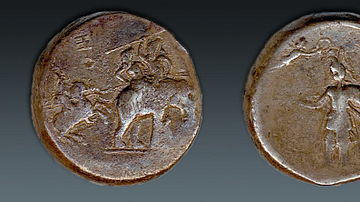
Alexander & Porus
A rare silver medallion decadrachm depicting Alexander the Great on horseback attacking King Porus on elephant; the reverse shows the Macedonian king holding a thunderbolt while being wreathed by Nike Babylon (?), c. 325/4-322/1...

Definition
Phoenicia
Phoenicia was an ancient civilization composed of independent city-states located along the coast of the Mediterranean Sea stretching through what is now Syria, Lebanon and northern Israel. The Phoenicians were a great maritime people...

Video
Alexander the Great | Top 5 Facts
City founder, natural leader and proud red head, here’s five shocking facts on the battle born Alexander the Great. For more historical facts and features, visit http://www.historyanswers.co.uk/ Or purchase...
Image
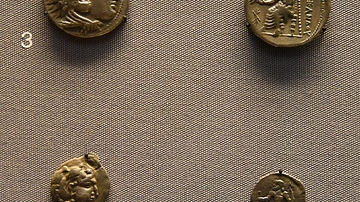
Coins from Macedonia and Sogdia Copying Alexander's Coinage
The State of Sogdia was conquered by the army of Alexander the Great in 327 BCE. The early coins from Sogdia copy the coins of Alexander's Empire, telling us that they were issued after the conquest...

Image
Map of Alexander the Great's Conquests
A map showing the route that Alexander the Great took to conquer Egypt, Mesopotamia, Persia, and Bactria.

Image
The Empire of Alexander the Great
A map showing the Empire of Alexander the Great, his conquests, and the routes he took (334 BC - 323 BC). Major cities, roads, and battles are indicated.

Image
Map of the Battle of Gaugamela - Alexander's Attack
A map of the battle of Gaugamela depicting Alexander the Great attacking Darius III, a move that led to victory.
