
Search
Remove Ads
Advertisement
Search Results

Image
Wall Block Inscribed with the Name of Alexander the Great
Marble wall block from the temple of Athena Polias at Priene, inscribed with the name of Alexander the Great, c. 334-330 BCE. The British Museum, London. Around 340 BCE, the inhabitants of Priene...
Image
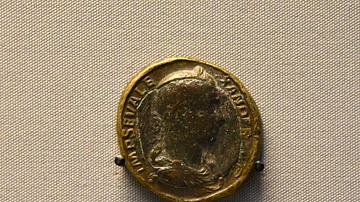
Bimetallic Medallion of Emperor Severus Alexander
Medallions with designs similar to coins could be worn as a symbol of allegiance, or given as prestigious gifts. They were specifically intended to be attractive, as display or presentation pieces. Bimetallic...

Video
Olympias: Mother to Alexander the Great and Second Wife of Phillip II of Macedon
Olympias, born with the name Myrtle, was the daughter of Neoptolemus, the king of Epirus, which was a Greek kingdom southwest of Macedonia and became the second wife of Philip...

Image
Map of the Cities Named Alexandria by Alexander the Great - How One Name Marked the Map of Conquest
The urban foundations of Alexander the Great (Alexander III of Macedon, reign 336–323 BCE) formed a deliberate component of his imperial strategy during his campaigns...

Image
Alexander Sarcophagus (detail)
The Alexander Sarcophagus is a late 4th century BCE stone sarcophagus adorned with bas-relief carvings of Alexander the Great. The Alexander Sarcophagus is one of four massive carved sarcophagi, forming two pairs...

Image
Alexander Severus (Artistic Facial Reconstruction)
A photorealistic artistic reconstruction of what the Roman emperor Alexander Severus (r. 222-235 CE) may have looked like. Based on contemporary and near contemporary descriptions, as well as archaeological...
Image
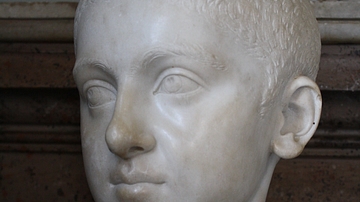
Severus Alexander Bust, Vatican Museums
A marble bust of Roman emperor Severus Alexander, r. 222-235 CE. (The Vatican Museums, Rome).

Image
Alexander Severus
Portrait of Roman Emperor Alexander Severus (reign: 222 – 235 CE), from Ostia Antica. (Palazzo Massimo alle Terme, Rome)

Image
Aristides & Alexander I, 479 BCE
Alexander I the Philhellene visits the Greek camp, revealing Mardonius' battle plans to the Athenian general Aristides.
Source: M. A. Barth - 'Vorzeit und Gegenwart', Augsbourg, 1832 CE
Image
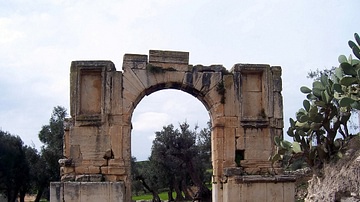
Arch of Alexander Severus, Dougga
The Arch of Alexander Severus is a Roman triumphal arch located in Dougga Tunisia (ancient Thugga). The arch was built in 228 CE, in gratitude to the emperor for his beneficence towards the city. It functioned as...
