
Search
Did you mean: Calypso?
Remove Ads
Advertisement
Search Results

Article
Battles & Conquests Of The Ottoman Empire (1299-1683)
Spanning across three continents and holding dominance over the Black and Mediterranean Seas, the Ottoman Sultanate (1299-1922) was a global military superpower between the 15th and 17th centuries...

Article
The Armies of the Crusades
The armies of the Crusades (11th-15th centuries CE), which saw Christians and Muslims struggle for control of territories in the Middle East and elsewhere, could involve over 100,000 men on either side who came from all...
Article
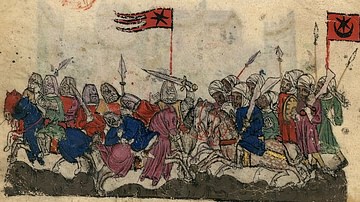
Battle of Yarmouk
The Battle of Yarmouk River (or Yarmuk River; also written as the Battle of Jabiya-Yarmuk) was fought over the course of six days, from 15 to 20 August 636 CE, between the Muslim army of the Rashidun Caliphate (632-661 CE), under...

Article
The Siege of Acre, 1291 CE
The Siege of Acre in 1291 CE was the final fatal blow to Christian Crusader ambitions in the Holy Land. Acre had always been the most important Christian-held port in the Levant, but when it finally fell on 18 May 1291...

Article
The Siege of Acre, 1189-91 CE
The Siege of Acre, located on the northern coast of Israel, was the first major battle of the Third Crusade (1189-1192 CE). The protracted siege by a mixed force of European armies against the Muslim garrison and nearby...
Article
Zengids & the Crusaders: Race for Egypt (1163-1169 CE)
In the aftermath of the failure of the Second Crusade (1147-1149 CE), which only managed to bring Damascus under Nur ad-Din's (sometimes also given as Nur al-Din, l. 1118-1174 CE) dominion, Egypt...

Article
Boran & Azarmiduxt: Queens of the Sassanian Empire
Boran (r. 630, 631-632) and Azarmiduxt (r. 630-631) were the only queens of the Sassanian Empire who ruled with the power of absolute monarchs. Daughters of Shahanshah (king of kings) Khosrow II (r...

Image
Cuneiform Tablet with Envelope from Alalakh
This clay tablet still has its clay envelope. The tablet mentions a legal case before Niqmepuh, King of Iamhad (Aleppo) concerning the legacy of two houses. The seal impressions of ten witnesses (including...

Image
Krak des Chevaliers
The castle of Krak des Chevaliers, Syria. Originally built for the Emir of Aleppo in 1031 CE, the castle was given to the Knights Hospitaller in 1144 CE, who extensively rebuilt it.
Image
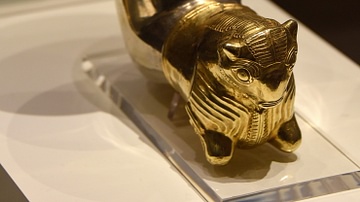
Achaemenid Silver and Gold Horn Cup
This object combines both Syrian and Persian styles. While the shape of the cup echoes a classical Persian wine-pourer (rhyton), it actually functioned as a drinking cup. Large animal-headed cups were popular in...
