
Search
Did you mean: Calypso?
Remove Ads
Advertisement
Search Results
Image
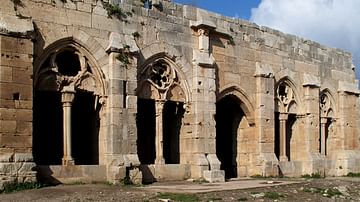
Hall of the Knights, Krak des Chevaliers
The Hall of the Knights at the castle of Krak des Chevaliers, Syria. Originally built for the Emir of Aleppo in 1031 CE, the castle was given to the Knights Hospitaller in 1144 CE, who extensively rebuilt it.
Image
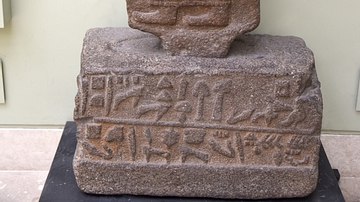
Goddess Kubaba
This image shows two objects: The free-standing basalt stele depicts the goddess Kubaba, consort of the storm god Teshub, and one of the most important deities at the city of Carchemish. Kubaba stands below a winged-disc and...

Image
Stela of the God Hadad
This basalt stela of the storm god Hadad of Aleppo was brought to the palace museum of King Nebuchadnezzar II as war booty. From Babylon, modern-day Iraq. Late Hittite period, 9th century BCE. (Istanbul Archaeological Museums/Ancient...
Image
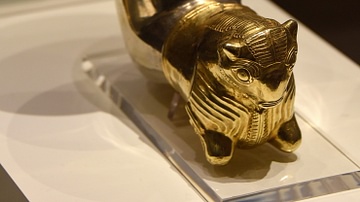
Achaemenid Silver and Gold Horn Cup
This object combines both Syrian and Persian styles. While the shape of the cup echoes a classical Persian wine-pourer (rhyton), it actually functioned as a drinking cup. Large animal-headed cups were popular in...
Image
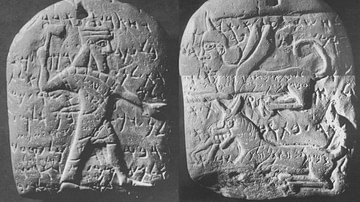
Arslan Tash Amulet AT1
The Arslan Tash Amulet AT1. Dated to the 7th century BCE, the Arslan Tash amulet (AT1) was discovered in Arslan Tash, Syria and contains the writing of Phoenician, magic incantations. (Archaeological Museum of Aleppo,Syria...
Image
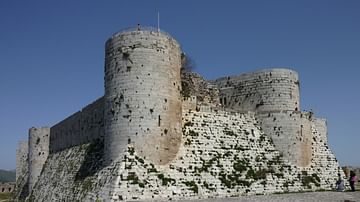
Mural Towers, Krak des Chevaliers
Mural towers of the castle of Krak des Chevaliers, Syria. Originally built for the Emir of Aleppo in 1031 CE, the castle was given to the Knights Hospitaller in 1144 CE, who extensively rebuilt it.
Image
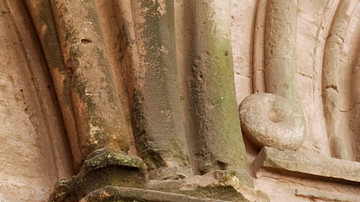
Decorative Corbel, Krak des Chevaliers
A decorative corbel at the castle of Krak des Chevaliers, Syria. Originally built for the Emir of Aleppo in 1031 CE, the castle was given to the Knights Hospitaller in 1144 CE, who extensively rebuilt it.
Image
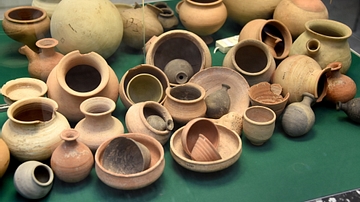
Pottery from the Amarneh Cemetery at Til Barsip
Much of the known pottery from the Euphrates region comes from tombs, often in large cemeteries attached to settlement sites. The tombs are of a variety of types, but most typically they consist of rock-cut...
Image
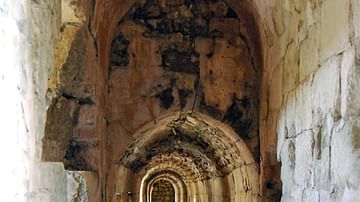
Mural Passage, Krak des Chevaliers
A mural passage (corridor built within a wall) at the castle of Krak des Chevaliers, Syria. Originally built for the Emir of Aleppo in 1031 CE, the castle was given to the Knights Hospitaller in 1144 CE, who extensively...

Image
Barrel-vaulted Chapel, Krak des Chevaliers
The barrel-vaulted chapel of the castle of Krak des Chevaliers, Syria. Originally built for the Emir of Aleppo in 1031 CE, the castle was given to the Knights Hospitaller in 1144 CE, who extensively rebuilt...
