
Search
Remove Ads
Advertisement
Search Results

Definition
Qilin (Chinese Unicorn)
The qilin (麒麟, or simply lin 麟) is a Chinese mythical creature, frequently translated as "Chinese unicorn." While this term may suggest a one-horned creature, the qilin is often depicted with two horns. However, like the...

Definition
Xunzi
Xunzi (pronounced shund-zee, l. c. 310-c. 235 BCE) was a Confucian philosopher of the Warring States Period (c. 481-221 BCE) in China. He is also known as Hun Kuang, Hsun Tzu, Xun Tzu, and Xun Kuang. Xunzi translates as Master Xun and...
Definition
Punt
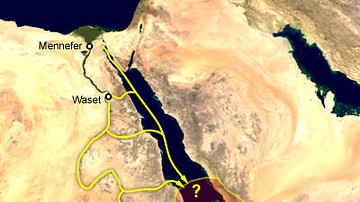
The Land of Punt was a region in Africa (most likely Somalia) referenced by inscriptions of ancient Egypt initially as a partner in trade and, later, as a semimythical country rich in resources and exotic goods. It is best known from the...

Definition
Shapur I
Shapur I (r. 240-270 CE) is considered one of the greatest kings of the Sassanian Empire for expanding his realm, his policy of religious tolerance, building projects, and committing the Zoroastrian scriptures (Avesta) to writing. He...

Article
The Report of Wenamun: Text & Commentary
The literature of the Middle Kingdom of Egypt (2040-1782 BCE) is justly famous as some of the best the culture ever produced. Great works like The Tale of the Shipwrecked Sailor and The Tale of Sinuhe stand...

Article
The Gifts of Isis: Women's Status in Ancient Egypt
An inscription on an Egyptian papyrus dating from the 2nd century CE relates that the goddess Isis, bestowing gifts on humanity at the beginning of time, gave as much power and honor to women as she...

Definition
Islamic Caliphates
Caliphate (“Khilafat” in Arabic) was a semi-religious political system of governance in Islam, in which the territories of the Islamic empire in the Middle East and North Africa and the people within were ruled by a supreme...

Article
The Three Estates of Pre-Revolutionary France
Society in the Kingdom of France in the period of the Ancien Regime was broken up into three separate estates, or social classes: the clergy, the nobility, and the commoners. These classes and their accompanying...

Article
Why Did Hitler Attack the USSR?
Adolf Hitler (1889-1945), the leader of Nazi Germany, was intent on attacking the USSR in the summer of 1941. With Western Europe subdued in 1940, Hitler could finally pursue his dream of territorial expansion in the...
Article
Legions of Syria
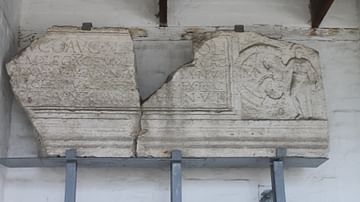
The Roman legions of Syria served as a buffer, protecting the Roman Empire not only externally from such threats as Parthia and the Sasanian Empire but also internally during the Great Jewish Revolt of 66 CE and the Bar-Kochba...
