
Search
Remove Ads
Advertisement
Search Results
Definition
Battle of Gaixia
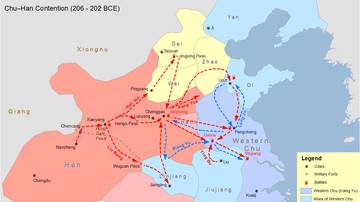
The Battle of Gaixia (202 BCE, also known as Kai-Hsia) was the decisive engagement of the Chu-Han Contention (206-202 BCE) at which Liu Bang (l. c. 256-195 BCE), from the State of Han, defeated Xiang Yu (l. 232-202 BCE) of the...

Definition
Rashidun Government
The Rashidun Caliphate (632-661 CE) was responsible for setting up the basis of the Islamic empire and expanding its borders beyond the Arabian soil. These leaders were selected by the consent of the people and based on their...

Definition
Sioux
The Sioux are a native North American nation who inhabited the Great Plains region of, roughly, modern Colorado, Montana, Nebraska, North Dakota, South Dakota, and Wyoming. They are one of the many nations referred to as Plains Indians...

Definition
William Still - Father of the Underground Railroad
William Still (1819-1902) was an African American abolitionist known as the "Father of the Underground Railroad" for his efforts in helping to free between 600 to 800 people from slavery. Born the son...

Definition
The Constantinian Excerpts - The 10th Century Byzantine Encyclopedia
The Constantinian Excerpts, or Excerpta Constantiniana is the conventional name given to the mid-10th Century Byzantine palace encyclopedia commissioned by the scholar emperor Constantine...

Article
David Walker's Appeal to the Coloured Citizens of the World
David Walker (l. c. 1796-1830) was an African American abolitionist writer best known for his 1829 work An Appeal to the Coloured Citizens of the World (also known The Appeal or Walker's Appeal...

Interview
Interview: The First Black Archaeologist: A Life of John Wesley Gilbert by John Lee
John Lee joins World History Encyclopedia to tell us all about his new book, The First Black Archaeologist: A Life of John Wesley Gilbert. Kelly (WHE): Thank you so much for...

Article
The Causes of WWII
The origins of the Second World War (1939-45) may be traced back to the harsh peace settlement of the First World War (1914-18) and the economic crisis of the 1930s, while more immediate causes were the aggressive invasions...

Definition
Mencius
Mencius (l. 372-289 BCE, also known as Mang-Tze or Mang-Tzu) was a Confucian philosopher during The Warring States Period in China (c. 481-221 BCE) and is considered the greatest after Confucius himself for his interpretation, formulation...

Article
US Presidential Election of 1800
The US presidential election of 1800, referred to by Jeffersonians as the Revolution of 1800, was a turning point in the early political history of the United States. It resulted in the victory of Vice President Thomas...
