
Search
Remove Ads
Advertisement
Search Results
Definition
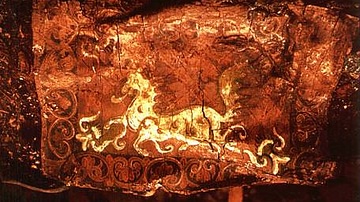
Cheonmachong
Cheonmachong is a 5-6th-century CE royal tomb of the ancient Silla kingdom of Korea located at the Daereungwon Tomb Complex in Gyeongju. It is popularly known as the 'Heavenly Horse Tomb' because of a painting of that animal on a...

Definition
Migration Age
The Migration Period, also called the Barbarian Invasions or German: Völkerwanderung (wandering of the peoples), was a period of human migration that occurred roughly between 300 to 700 CE in Europe, marking the transition from...

Definition
Taejo of Goryeo
Taejo (r. 918-943 CE), previously known as Wang Geon or Wang Kon, was the founder and first king of the Goryeo (Koryo) kingdom which unified and ruled ancient Korea from 918 CE to 1392 CE. Wang Geon was given the posthumous title...

Definition
Diocletian
Diocletian was Roman emperor from 284 to 305 CE. After the defeat and death of the Roman emperor Philip the Arab in 249 CE, the empire endured over three decades of ineffective rulers. The glory days of Augustus, Vespasian, and Trajan...

Definition
Jang Bogo - Korea's King of the Yellow Sea
Jang Bogo (aka Chang Pogo or Gungbok) was a powerful Korean warlord, naval commander, and merchant who came to monopolise maritime trade in northeast Asia to such a degree that he was known as the 'King of...

Definition
Writing - The Preservation of Human Thought and Action
Writing is the physical manifestation of a spoken language. It is thought that human beings developed language circa 35,000 BCE as evidenced by cave paintings from the period of the Cro-Magnon Man...
Definition
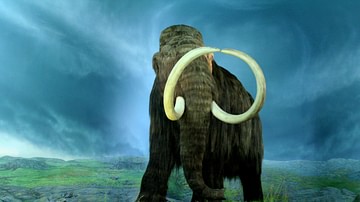
Woolly Mammoth
The woolly mammoth, Mammuthus primigenius, is an extinct herbivore related to elephants who trudged across the steppe-tundras of Eurasia and North America from around 300,000 years ago until their numbers seriously dropped from...

Definition
Hatti
The Hatti were an aboriginal people in central Anatolia (present-day Turkey) who first appeared in the area around the River Kizil Irmak. The prevailing understanding is that they were native to the land although it has been suggested...

Definition
Anu - Mesopotamian Father of the Gods
Anu (also known as An) is an early Mesopotamian sky god who was later viewed as the Father of the Gods and ruler of the heavens, a position which then passed to his son Enlil. He is the son of the couple Anshar...

Definition
Sphinx
A sphinx is a mythical creature with the body of a lion, most often with a human head and sometimes with wings. The creature was an Egyptian invention and had a male head - human or animal; however, in Greek mythology, the creature had...
